• Request More Info
  • Visit
  • Apply
  • Give
  • Request More Info
  • Visit
  • Apply
  • Give

Search

  • A-Z Index
  • Map

History

  • About
    • Why Study History?
    • Areas of Study
    • Faculty Publications
    • The Jangle Podcast
    • Alumni Profiles
    • Contact Us
    • Give
  • People
    • Faculty
    • Teaching Faculty
    • Research Faculty
    • Associated Faculty
    • Staff
    • Graduate Students
    • Emeriti
  • Undergraduate
    • Majors / Minors
    • Declare
    • Honors Program
    • Advising
    • Classes
    • Beyond the Classroom
    • Careers
    • Scholarships & Awards
  • Graduate
    • Concentrations
    • MA Program
    • PhD Program
    • Apply
    • Funding
    • Forms
    • Graduate Handbook
  • Community Engagement
    • Local Histories
    • Summer Bridge Program
    • Bridge to AP U.S. History
    • Papers of Andrew Jackson
    • Tennesseans and War
  • News & Events
    • News
    • Events
    • Public Lecture Series
    • Newsletters
  • Share Your News

Arguing until Doomsday
Arguing until Doomsday

November 12, 2023

topography background

Faculty Publications

arguing-until-doomsday
(University of North Carolina Press, 2020)
View Publication Page

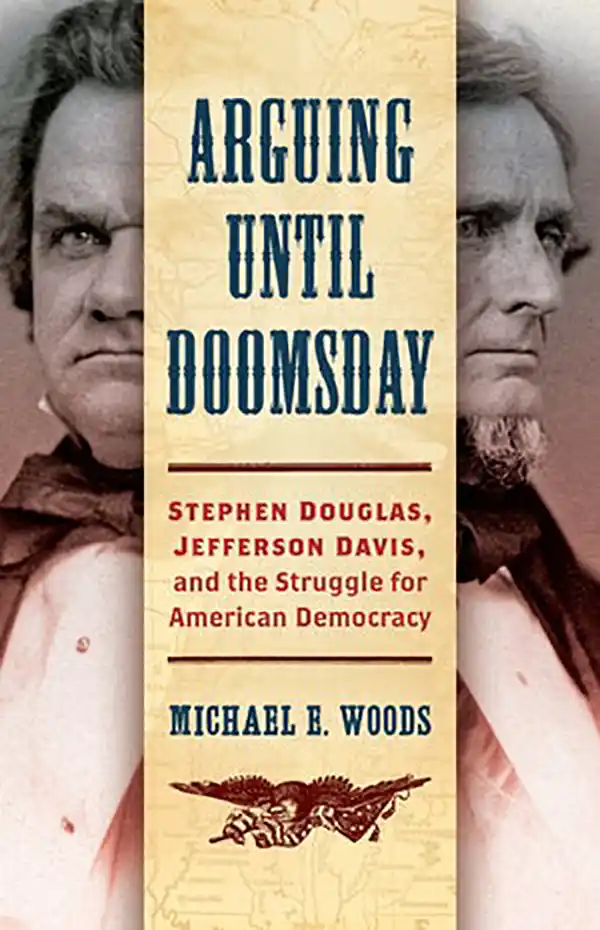
Arguing until Doomsday

by Michael Woods

As the sectional crisis gripped the United States, the rancor increasingly spread to the halls of Congress. Preston Brooks’s frenzied assault on Charles Sumner was perhaps the most notorious evidence of the dangerous divide between proslavery Democrats and the new antislavery Republican Party. But as disunion loomed, rifts within the majority Democratic Party were every bit as consequential. And nowhere was the fracture more apparent than in the raging debates between Illinois’s Stephen Douglas and Mississippi’s Jefferson Davis. As leaders of the Democrats’ northern and southern factions before the Civil War, their passionate conflict of words and ideas has been overshadowed by their opposition to Abraham Lincoln.

But here, weaving together biography and political history, Michael E. Woods restores Davis and Douglas’s fatefully entwined lives and careers to the center of the Civil War era. Operating on personal, partisan, and national levels, Woods traces the deep roots of Democrats’ internal strife, with fault lines drawn around fundamental questions of property rights and majority rule. Neither belief in white supremacy nor expansionist zeal could reconcile Douglas and Davis’s factions as their constituents formed their own lines in the proverbial soil of westward expansion. The first major reinterpretation of the Democratic Party’s internal schism in more than a generation, Arguing until Doomsday shows how two leading antebellum politicians ultimately shattered their party and hastened the coming of the Civil War.

History

College of Arts and Sciences

916 Volunteer Blvd
6th Floor, Stokely Management Center
Knoxville, TN 37996
Phone: 865-974-5421
Email: history@utk.edu


Facebook Icon    X Icon    Instagram Icon    Soundcloud Icon

Department Intranet

The History department has transferred all internal documentation shared by faculty, graduate students, and staff to a Microsoft SharePoint site. Only those with permission may access this area.

The University of Tennessee, Knoxville
Knoxville, Tennessee 37996
865-974-1000

The flagship campus of the University of Tennessee System and partner in the Tennessee Transfer Pathway.

ADA Privacy Safety Title IX