• Request More Info
  • Visit
  • Apply
  • Give
  • Request More Info
  • Visit
  • Apply
  • Give

Search

  • A-Z Index
  • Map

History

  • About
    • Why Study History?
    • Areas of Study
    • Faculty Publications
    • The Jangle Podcast
    • Alumni Profiles
    • Contact Us
    • Give
  • People
    • Faculty
    • Teaching Faculty
    • Research Faculty
    • Associated Faculty
    • Staff
    • Graduate Students
    • Emeriti
  • Undergraduate
    • Majors / Minors
    • Declare
    • Honors Program
    • Advising
    • Classes
    • Beyond the Classroom
    • Careers
    • Scholarships & Awards
  • Graduate
    • Concentrations
    • MA Program
    • PhD Program
    • Apply
    • Funding
    • Forms
    • Graduate Handbook
  • Community Engagement
    • Local Histories
    • Summer Bridge Program
    • Bridge to AP U.S. History
    • Papers of Andrew Jackson
    • Tennesseans and War
  • News & Events
    • News
    • Events
    • Public Lecture Series
    • Newsletters
  • Share Your News

Regeneration through Empire: French Protonatalists and Colonial Settlement in the Third Republic
Regeneration through Empire: French Protonatalists and Colonial Settlement in the Third Republic

November 12, 2015

topography background

Faculty Publications

regeneration-through-empire-french-protonatalists-and-colonial-settlement-in-the-third-republic
(University of Nebraska Press, 2015)
View Publication Page

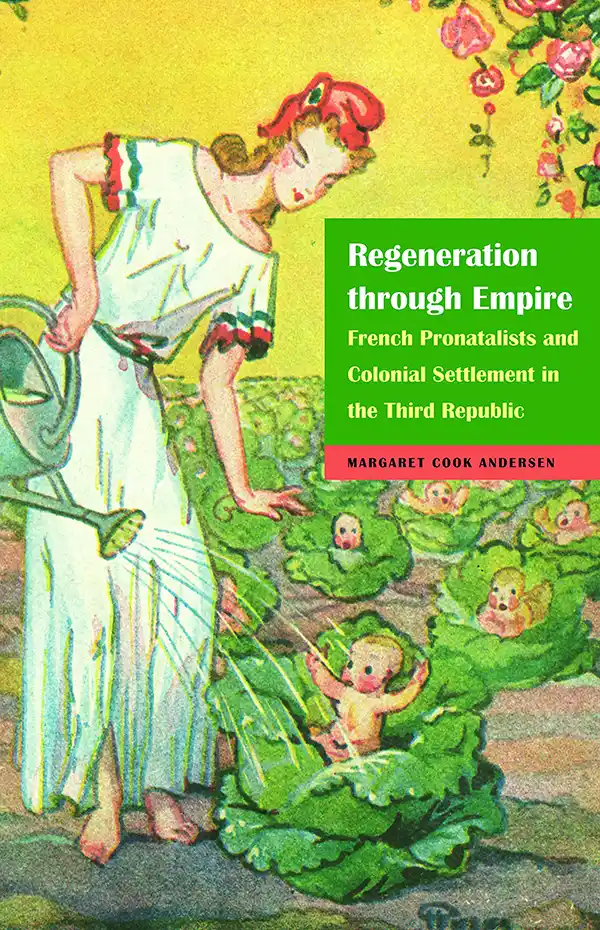
Regeneration through Empire: French Protonatalists and Colonial Settlement in the Third Republic

by Margaret Andersen

Following France’s defeat in the Franco-Prussian War in 1870–71, French patriots feared that their country was in danger of becoming a second-rate power in Europe. Decreasing birth rates had largely slowed French population growth, and the country’s population was not keeping pace with that of its European neighbors. To regain its standing in the European world, France set its sights on building a vast colonial empire while simultaneously developing a policy of pronatalism to reverse these demographic trends. Though representing distinct political movements, colonial supporters and pronatalist organizations were born of the same crisis and reflected similar anxieties concerning France’s trajectory and position in the world.

Regeneration through Empire explores the intersection between colonial lobbyists and pronatalists in France’s Third Republic. Margaret Cook Andersen argues that as the pronatalist movement became more organized at the end of the nineteenth century, pronatalists increasingly understood their demographic crisis in terms that transcended the boundaries of the metropole and began to position the French empire, specifically its colonial holdings in North Africa and Madagascar, as a key component in the nation’s regeneration. Drawing on an array of primary sources from French archives, Regeneration through Empire is the first book to analyze the relationship between depopulation and imperialism.

History

College of Arts and Sciences

916 Volunteer Blvd
6th Floor, Stokely Management Center
Knoxville, TN 37996
Phone: 865-974-5421
Email: history@utk.edu


Facebook Icon    X Icon    Instagram Icon    Soundcloud Icon

Department Intranet

The History department has transferred all internal documentation shared by faculty, graduate students, and staff to a Microsoft SharePoint site. Only those with permission may access this area.

The University of Tennessee, Knoxville
Knoxville, Tennessee 37996
865-974-1000

The flagship campus of the University of Tennessee System and partner in the Tennessee Transfer Pathway.

ADA Privacy Safety Title IX