UT History Department Documents Key Year in Andrew Jackson’s Presidency
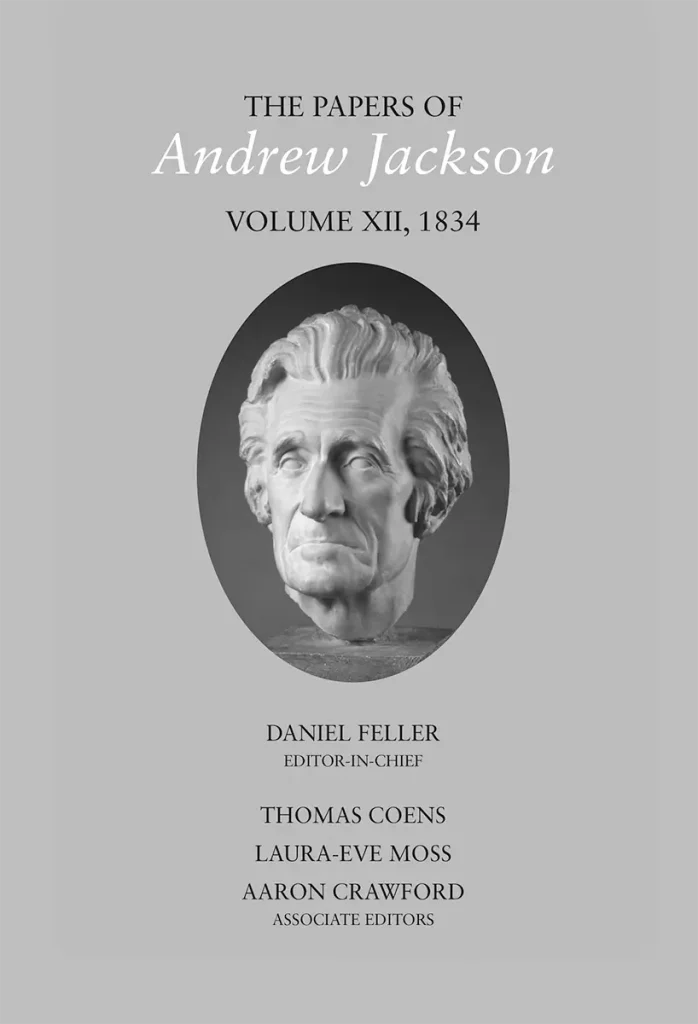
In partnership with UT Press, the UT Department of History has published the 1834 volume of The Papers of Andrew Jackson.
“For Jackson, 1834 was the year a controversy that had smoldered throughout his first five years as president of the United States reached a point of crisis,” said Daniel Feller, chief editor of the papers project.
The controversy concerned the Bank of the United States, an institution incorporated by Congress to head the nation’s financial system. Believing that the Bank corruptly privileged “the rich and powerful” over “the humble members of society—the farmers, mechanics, and laborers,” Jackson had set out to destroy it, first by vetoing a renewal of its charter and then by pulling the government’s money from its vaults. For this, the United States Senate censured Jackson—the only time in our history that has happened. Jackson, unbowed, returned a scathing protest, asserting the president’s authority to act as “the direct representative of the American people.” Privately he took to calling the Bank “the golden calf” and “this whore of Babylon.”
As the new volume shows, the Bank War was one of many controversies roiling Jackson’s presidency in 1834. Throughout the year Jackson pursued his aim of compelling eastern Indians to remove west of the Mississippi. In May the Chickasaws, under relentless pressure, signed a removal treaty. But brazen frauds complicated Jackson’s scheme to induce Creek emigration from Alabama, while the Cherokees, led by principal chief John Ross and backed by many white sympathizers, stood fast in resistance.
In 1834 Jackson continued his longstanding effort to pry the province of Texas loose from Mexico. Other matters engaging Jackson included corruption scandals in the Post Office Department and at Mississippi land offices, fractious disputes over rank and seniority among Army and Navy officers, and a fire that gutted Jackson’s Hermitage home in Tennessee.
These stories and many more are told in The Papers of Andrew Jackson: Volume XII, 1834. Presenting more than 500 original documents—public and private letters, memoranda, and official papers—in full annotated text, the volume is the latest installment in an ongoing series that has been called “the gold standard of historical documentary editing.”
Volume XII is the sixth and last produced under the editorship of Daniel Feller, now Distinguished Professor Emeritus at the University of Tennessee, Knoxville. Associate Editors Thomas Coens and Laura-Eve Moss are UT research faculty in history. The index was completed under Michael Woods, Feller’s successor as UT history professor and Jackson editor. Financial support was provided by the UT College of Arts and Sciences as well as the National Endowment for the Humanities, the National Historical Publications and Records Commission, the Tennessee Historical Commission, and the Watson-Brown Foundation.