

• Request More Info
  • Visit
  • Apply
  • Give
  • Request More Info
  • Visit
  • Apply
  • Give

Search

A-Z Index Map

History

  • About
    • Why Study History?
    • Areas of Study
    • Faculty Publications
    • The Jangle Podcast
    • Alumni Profiles
    • Contact Us
    • Give
  • People
    • Faculty
    • Teaching Faculty
    • Research Faculty
    • Associated Faculty
    • Staff
    • Graduate Students
    • Emeriti
  • Undergraduate
    • Majors / Minors
    • Declare
    • Honors Program
    • Advising
    • Classes
    • Beyond the Classroom
    • Careers
    • Scholarships & Awards
  • Graduate
    • Concentrations
    • MA Program
    • PhD Program
    • Apply
    • Funding
    • Forms
    • Graduate Handbook
  • Community Engagement
    • Local Histories
    • Summer Bridge Program
    • Bridge to AP U.S. History
    • Papers of Andrew Jackson
    • Tennesseans and War
  • News & Events
    • News
    • Events
    • Public Lecture Series
    • Newsletters
  • Share Your News
topography background

News

News

A video game player holding a controller

Tore Olsson in ‘The Conversation’: Why I turned the ‘Red Dead Redemption II’ video game into a history class on America’s violent past

July 22, 2024

a video game player holding a controller
The video game ‘Red Dead Redemption II’ has sold over 64 million copies. Can it be used to teach history, too? MTStock Studio via Getty Images
Tore Olsson, University of Tennessee
Text saying: Uncommon Courses, from The Conversation

Uncommon Courses is an occasional series from The Conversation U.S. highlighting unconventional approaches to teaching.

Title of course:

Red Dead’s History: Exploring America’s Violent Past Through the Hit Video Game

What prompted the idea for the course?

This course was born during the COVID-19 pandemic. Confronting the lockdowns of 2020 and uncertain months spent at home, I rekindled a high school hobby that I had neglected for two decades – video gaming.

One of the first games I picked up was “Red Dead Redemption II,” set in a fictionalized America of 1899. The game follows the Van der Linde gang, a diverse crew of idealistic outlaws, as they flee authority in an increasingly ordered and hierarchical world. Since its 2018 release, the game has sold more than 64 million copies, making it the seventh on the list of all-time bestselling video games – and the only historically themed one on the list.

While video games had been a mindless pastime in high school, this time around I was playing as a professor who specialized in U.S. history since the Civil War. And though that made me a far more critical gamer, I was also genuinely surprised at how often RDRII – as it is often called – alluded to major topics that historians have spent generations debating.

These topics include corporate capitalism, settler colonialism, women’s suffrage and the inequalities of race in an era that Mark Twain had called the “Gilded Age” – a period where the dazzling wealth of a small handful sharply contrasted with the misery of common people. These weighty topics were often on the game’s sidelines, rather than at center stage – but they were present nevertheless.

It wasn’t long into my playthrough that an epiphany struck me. Given how wildly popular this game was with college-age Americans, why not try teaching a serious history course that used the fictional content of the games as a springboard to jump into some of the thorniest dilemmas of the American past?

The experiment proved a success. The course was wildly popular with students and also garnered wide media coverage for its unusual approach to teaching with pop culture.

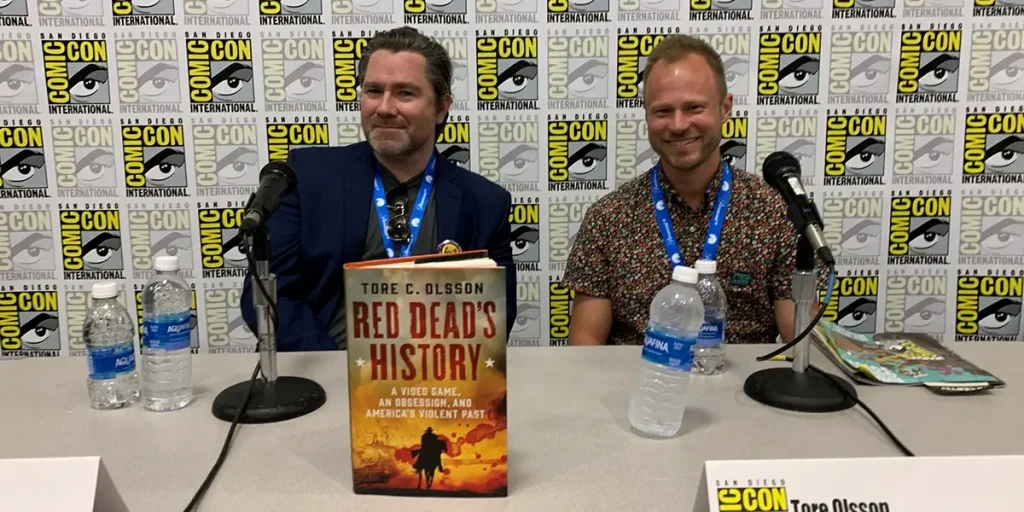
Encouraged by this response, I’ve now adapted the course into a book for both gamers and history buffs around the world, titled “Red Dead’s History: A Video Game, An Obsession, and America’s Violent Past,” set to be released in August 2024. An extra bonus is that the audiobook version will be narrated by Roger Clark, who played RDRII’s protagonist.

What does the course explore?

Given the centrality of violence to the video game, the course seeks to understand what really spurred bloodshed in the United States between 1865 and 1920.

In RDRII, gunfire is usually sparked by personal grudges, robberies or the overconsumption of alcohol. But in Gilded Age America, it wasn’t so simple. Instead, broader social problems were the primary catalyst of violence. First, Americans fought over the emerging regime of corporate capitalism. Should new businesses like U.S. Steel and the Union Pacific Railroad, who wielded never-before-seen power and influence, dominate workers and consumers alike? Many resisted such an idea through protests, strikes and sometimes bloodshed.

Secondly, Americans came to blows over the unfulfilled promises of racial equality that were written into the U.S. Constitution after the Civil War. Especially in the South, where the vast majority of African Americans lived, the formerly enslaved and their descendants demanded inclusion in politics and a chance to progress economically. But many white Southerners resisted such efforts, often using terrorism to push their Black neighbors into subservient positions.

Why is this course relevant now?

American society in the late 19th century was ruptured by inequalities wrought by capitalism and race – and so is ours today. In the wake of Black Lives Matter and Occupy Wall Street, it’s wise that we look back at the long road that brought America to its contemporary dilemmas of racial violence and the gap between rich and poor. A handy way to open that conversation with young Americans is through video games – an industry that has now surged in value to eclipse both music and movies, and which might be the key to reaching this generation’s students, as studies are beginning to show.

A young man plays a video game.
Video games are proving to be an effective way to reach today’s students. Chesnot via Getty Images

What’s a critical lesson from the course?

One key lesson is about the city of New Orleans, fictionalized in RDRII as “Saint Denis.” In the game, the outlaw protagonists trade fire with the city’s blue-coated policemen following a botched bank robbery, leaving bodies in the streets. Few gamers could guess that a similarly bloody firefight with the police riveted the real city in 1900, just a year after the game is set, leaving seven officers dead. Yet here the outlaw was a Black man, Robert Charles, who took a violent stand against police abuse and the emerging system of Jim Crow segregation.

In response to his attacks on the police, white mobs roamed the city and indiscriminately killed Black civilians. Therefore, the explosion of violence in New Orleans was produced not by simple banditry but by one of America’s towering social dilemmas.

What materials does the course feature?

I frequently begin course sessions with a brief video cutscene or gameplay footage from RDRII, before we dive into the actual history that the games represent – or sometimes, misrepresent. For reading, students dive into scholarly monographs such as historian K. Stephen Prince’s “The Ballad of Robert Charles”, on the violent dilemmas of race in New Orleans. They also read a range of original sources, such as cowboy memoirs, train schedules and a Texas newspaper from 1899.

What will the course prepare students to do?

Anyone who has taken my class – or read my new book – will know that the big social problems we are wrestling with today have deep roots, and took their modern shape during the same 1865-1920 period that is memorably captured in RDRII. They’ll also become much more discerning consumers of digital media, and games in particular; they’ll be better able to assess and critique representations of history on the digital screen.The Conversation

Tore Olsson, Associate Professor of History, University of Tennessee

This article is republished from The Conversation under a Creative Commons license. Read the original article.

Filed Under: News

Headshot photo of Bruce Wheeler

Remembering Professor Bruce Wheeler (1939-2023)

April 2, 2024

Bruce Wheeler headshot photo

Tuesday, April 9, the UT Department of History and the Knoxville History Project will join forces to honor the late Professor Bruce Wheeler. Wheeler joined the history department in 1970 and served our campus and community for more than four decades. 

The program’s speakers will recognize his many accomplishments. He was a distinguished historian who wrote an important history of Knoxville; he was an engaging and innovative teacher beloved by a generation of UT students; and he generously contributed his time to help improve history education in East Tennessee public schools. During his long career, he was recognized with numerous teaching awards, and served as the head of the University’s Honors Program before his retirement in 2003.

Hosted by Jack Neely of the Knoxville History Project, the free public program will be held in the upstairs room at Maple Hall, 414 S. Gay Street, at 6 p.m. Tuesday, Apr 9, 2024. 

Filed Under: News

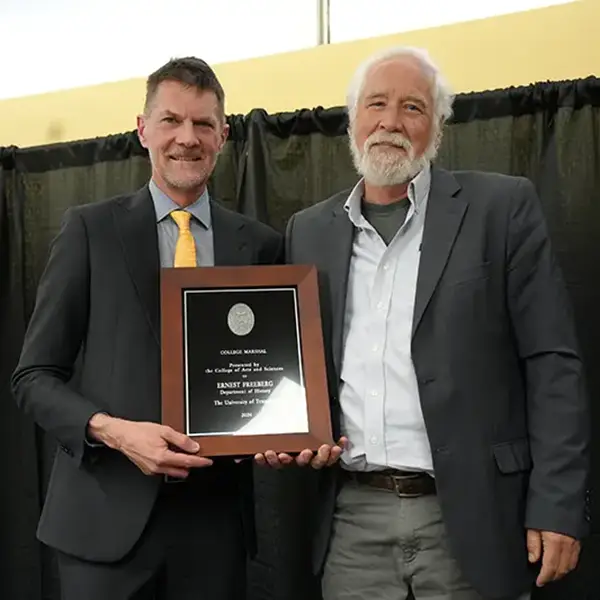
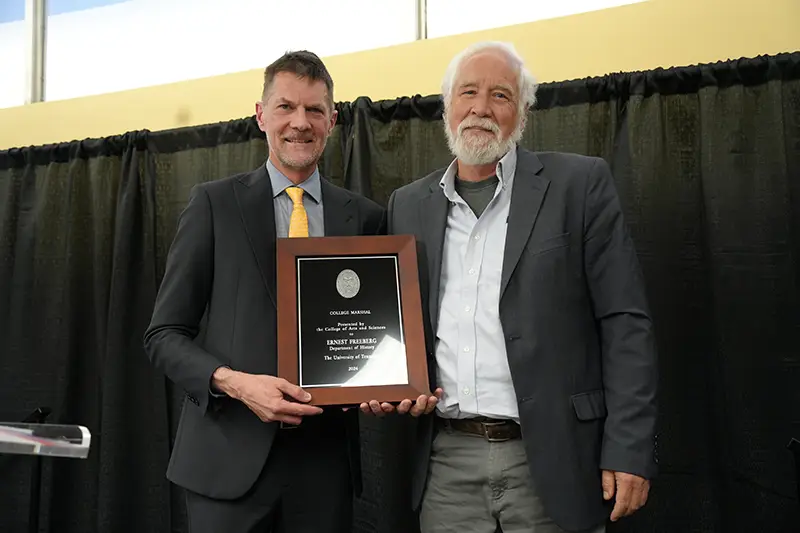
Ernest Freeberg receives an award from Robert Hinde at the 2023 Faculty Awards Convocation

Freeberg Named 2023 William and Vicki Brakebill College Marshal
March 27, 2024

Ernest Freeberg receives an award from Robert Hinde at the 2023 Faculty Awards Convocation

Ernest Freeberg, professor of history, was named the 2023 William and Vicki Brakebill College Marshal during the UT College of Arts and Sciences Faculty Convocation. The William and Vicki Brakebill College Marshal Award is the college equivalent of the university macebearer and is, therefore, the highest college honor awarded to a member of the faculty.

Freeberg stepped onto the UT campus in 2003 and began his 20+ years as a Volunteer. His long standing service to our college and the university, as well as his record of outstanding scholarship is why we honor him with the William and Vicki Brakebill College Marshal Award award this evening. He served as department head for history from 2013 until 2022, and holds the titles of both Beaman Professor and Distinguished Professor of the Humanities. 

His research has been supported by grants from the American Council of Learned Societies, the Huntington Library, Newberry Library, and others. His two most recent books, A Traitor to His Species: Henry Bergh and the Birth of the Animal Rights Movement and The Age of Edison: Electric Light and the Invention of Modern America are notable not only for their scholarly excellence, but also accessibility to a general audience, who he knows well from his several years on the board of the Knoxville History Project. 
Filed Under: News

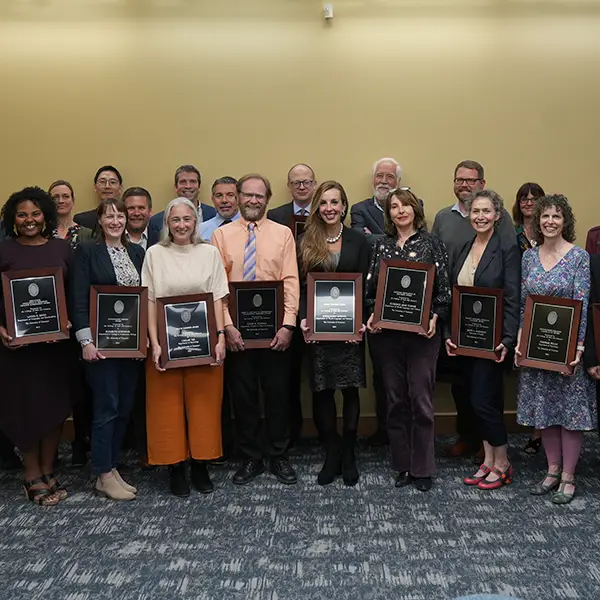
Group photo of awardees at the 2023 Faculty Awards Convocation

Bauer, Sanft Honored for Research Excellence

March 27, 2024

Brooke Bauer, assistant professor of history, and Charles Sanft, professor of history, received awards for excellence in research during the 2023 College of Arts and Sciences Faculty Convocation.

Brooke Bauer, Assistant Professor

Excellence in Research & Creative Achievement Awards: Early Career
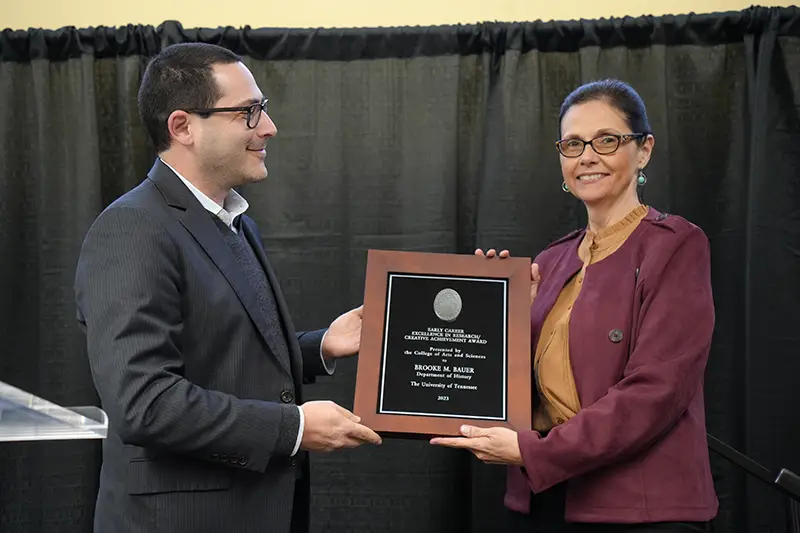
Brooke Bauer receives an award from Michael Blum at the Faculty Awards Convocation

Bauer’s book, Becoming Catawba: Catawba Indian Women and Nation Building, 1500-1940, published in November 2022, won three book prizes in 2022-2023. The South Carolina Historical Society, the American Society for Ethnohistory, and the Berkshire Conference of Women Historians have all lauded its innovative interdisciplinary methodology and its deeply felt narration of Catawba women’s struggle for survival and identity.

Bauer has now embarked on an exciting research trajectory, co-authoring a book that explores how the histories of tribal nations are represented (and misrepresented) in museums and historical sites, among other projects. She has demonstrated remarkable originality and nuance in the histories she researches and writes. These traits are recognized with this Early-Career Research Award.


Charles Sanft, Department of History

New Research, Scholarly and Creative Projects in the Arts & Humanities
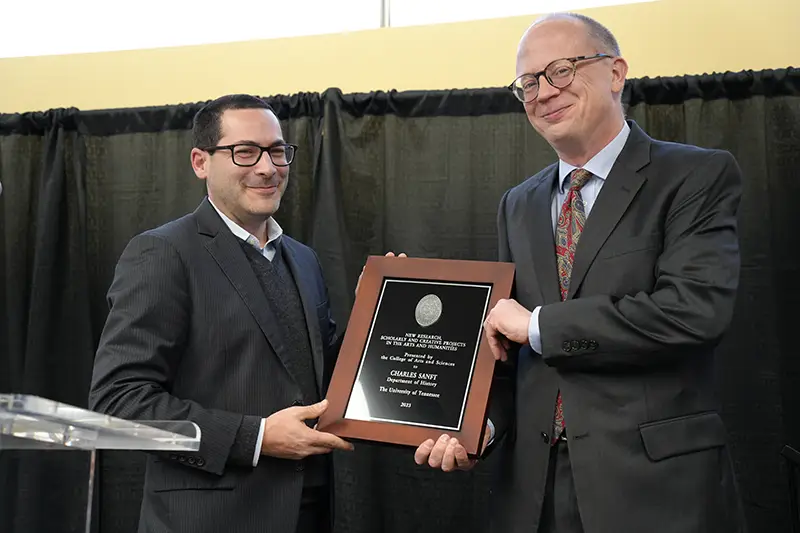
Charles Sanft receives an award from Michael Blum at the Faculty Awards Convocation

Sanft is working on a fascinating book project, Twenty Poems from Dunhuang. This work focuses on a unique set of ninth-century manuscripts describing the literal and metaphorical landscapes of a desert oasis town in northwestern China.

The significance of Sanft’s project is not simply bringing rare early Chinese medieval texts to a twenty-first century audience, but also his interdisciplinary approach. He examines these poems as historical sources, as literary imaginings, and as material objects. While in Dunhuang, he intends to visit places identified in the poems to gain experiential understanding of their relative locations and environmental characteristics.

Weaving these insights together in the introduction to the poems and then in his commentary on each individual poem will offer readers a remarkably textured analysis of these short, but powerful, texts.

Filed Under: News

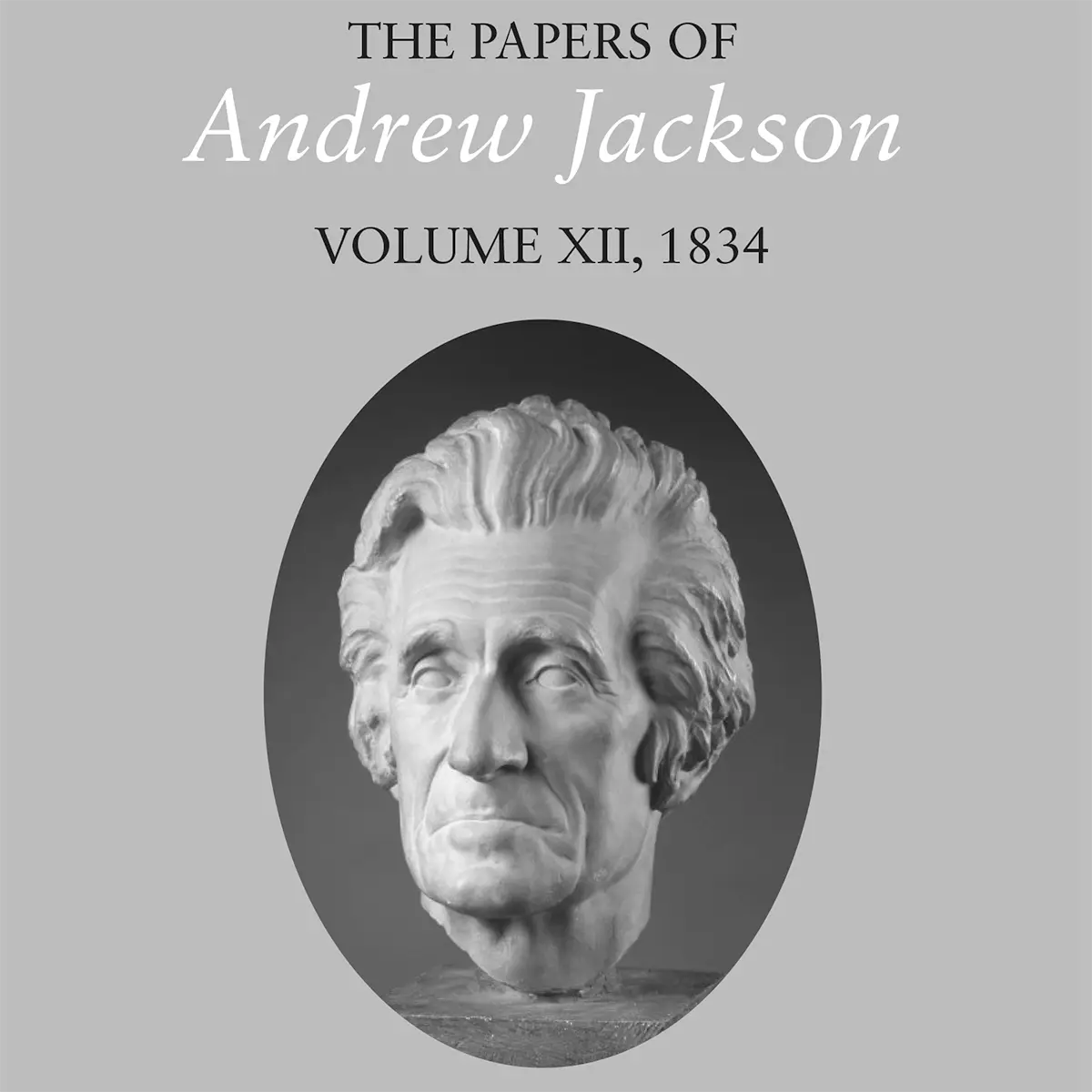
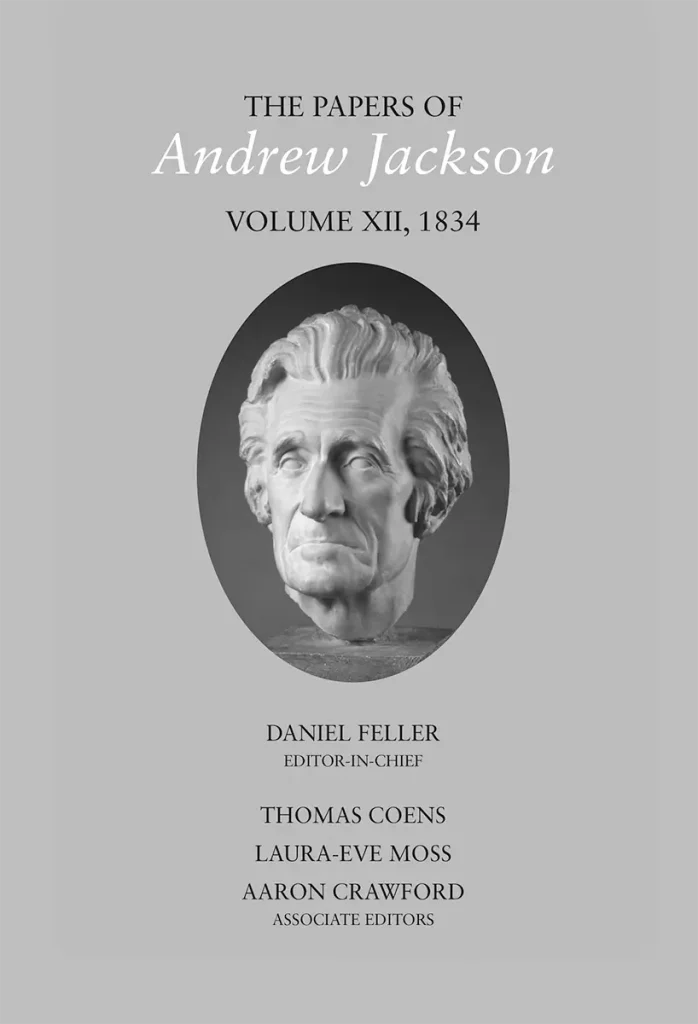
Cover of the Papers of Andrew Jackson Volume 12, with a photo of a bust of Andrew Jackson

UT History Department Documents Key Year in Andrew Jackson’s Presidency
March 14, 2024

-Story by Ernest Freeberg, professor of UT history

Cover of the Papers of Andrew Jackson Volume 12, with a photo of a bust of Andrew Jackson

In partnership with UT Press, the UT Department of History has published the 1834 volume of The Papers of Andrew Jackson.

“For Jackson, 1834 was the year a controversy that had smoldered throughout his first five years as president of the United States reached a point of crisis,” said Daniel Feller, chief editor of the papers project. 

The controversy concerned the Bank of the United States, an institution incorporated by Congress to head the nation’s financial system. Believing that the Bank corruptly privileged “the rich and powerful” over “the humble members of society—the farmers, mechanics, and laborers,” Jackson had set out to destroy it, first by vetoing a renewal of its charter and then by pulling the government’s money from its vaults. For this, the United States Senate censured Jackson—the only time in our history that has happened. Jackson, unbowed, returned a scathing protest, asserting the president’s authority to act as “the direct representative of the American people.” Privately he took to calling the Bank “the golden calf” and “this whore of Babylon.”  

As the new volume shows, the Bank War was one of many controversies roiling Jackson’s presidency in 1834. Throughout the year Jackson pursued his aim of compelling eastern Indians to remove west of the Mississippi. In May the Chickasaws, under relentless pressure, signed a removal treaty. But brazen frauds complicated Jackson’s scheme to induce Creek emigration from Alabama, while the Cherokees, led by principal chief John Ross and backed by many white sympathizers, stood fast in resistance. 

In 1834 Jackson continued his longstanding effort to pry the province of Texas loose from Mexico. Other matters engaging Jackson included corruption scandals in the Post Office Department and at Mississippi land offices, fractious disputes over rank and seniority among Army and Navy officers, and a fire that gutted Jackson’s Hermitage home in Tennessee. 

These stories and many more are told in The Papers of Andrew Jackson: Volume XII, 1834. Presenting more than 500 original documents—public and private letters, memoranda, and official papers—in full annotated text, the volume is the latest installment in an ongoing series that has been called “the gold standard of historical documentary editing.” 

Volume XII is the sixth and last produced under the editorship of Daniel Feller, now Distinguished Professor Emeritus at the University of Tennessee, Knoxville. Associate Editors Thomas Coens and Laura-Eve Moss are UT research faculty in history. The index was completed under Michael Woods, Feller’s successor as UT history professor and Jackson editor. Financial support was provided by the UT College of Arts and Sciences as well as the National Endowment for the Humanities, the National Historical Publications and Records Commission, the Tennessee Historical Commission, and the Watson-Brown Foundation.  

Filed Under: News

Photo of Brooke Bauer

Bauer’s ‘Becoming Catawba’ Earns Best Ethnohistory Award

January 4, 2024

Brooke Bauer

Brooke Bauer, assistant professor in the Department of History, received the 2023 Erminie Wheeler-Voegelin Book Award from the American Society for Ethnohistory (ASE) for her book, Becoming Catawba: Catawba Indian Women and Nation Building, 1540-1840 (2023).

The award recognizes the best book in the field of ethnohistory published in the last year. Bauer’s work investigates Catawba women as central characters in the history of the Catawba people, examining their vital roles as women, mothers, providers, and protectors to reveal how they created and maintained an identity for their people and helped build a nation.

In citing the book’s award-winning qualities, the ASE wrote, “Bauer constructs a riveting narrative about how the communities, economies, families, and polities of Catawbas in the Carolinas became intricately entwined and maintained over three centuries of turmoil brought about by European and US colonialism. In so doing, she crafts not only a powerful counter narrative to male-dominated stories of colonial diplomacy and warfare, but also a narrative of national creation and building rather than one of decline.”

ASE also noted Bauer’s careful research, interdisciplinary source-mining, and convincing arguments forged an “entirely engaging” story, writing, “Bauer shows how to combine family research with archaeological and documentary research with huge rewards for specialists and non-specialists alike.”

Bauer’s award-winning exploration of this regional history exemplifies the Volunteer connection to community, illuminating the past to understand our world today.

Filed Under: News

Empty bowls at a refugee camp in Kenya. Author provided

Nicole Eggers Published in ‘The Conversation’

December 14, 2023

‘You reach a point where you have nothing. You will just die’ – in East African refugee camps, food scarcity is a mortal concern

a photo from a refuge camp
Empty bowls at a refugee camp in Kenya. Author provided
Roger B. Alfani, Seton Hall University and Nicole Eggers, University of Tennessee

For refugees living in settlements across Africa, life got more difficult in 2023.

Shortfalls in the operating budget of the United Nations refugee agency, UNHCR, and the World Food Program have brought increased precarity into the daily lives of millions of displaced people across the continent.

Having fled violence, famine and insecurity in search of survival, many African refugees now find themselves faced with similar circumstances in the very spaces designed to protect them. Most notably, over the past year, refugees in Central and East Africa have watched as their food rations and living stipends – already meager – have been cut to unsustainably low levels.

In Africa’s largest refugee-hosting country, Uganda, the budget for UNHCR programs is currently funded at only 39% of its needs. Burundi, which has experienced a 35% increase in its refugee population since 2018, as well as a large increase in the number of returned Burundian refugees, has seen its own budget increase by only 12% in that same period.

The reasons for these shortfalls are multifaceted, including the lasting effects of the COVID-19 pandemic and the Russia-Ukraine war, which has affected food production and resulted in an increase of prices. Though refugees themselves say they are offered little explanation – “They just tell us that the order came from Geneva,” one refugee told us in reference to UNHCR’s headquarters in the Swiss capital.

The resulting cuts in food security programs have had devastating effects on refugee families and communities.

We spent three months in Africa this past summer interviewing over 200 refugees across seven refugee camps and urban refugee havens in Burundi, Uganda and Kenya. While we were there to primarily investigate the role of faith and religious community among refugees from the Democratic Republic of Congo, our interviews touched on many aspects of the refugee experience. All names used in this article have been changed to protect the interviewees identity.

‘Just not enough’

Cuts in food rations were on the minds of nearly all of the refugees whom we interviewed this summer.

In Burundi, for example, a number of refugees explained to us how 2023’s rations for their daily dietary staple – cornflour used to make a hard porridge known locally as “bukari” – had been cut from 10 kilograms (22 pounds) per month to three kilograms (6.6 pounds). One refugee in the Bwagiriza refugee settlement in Burundi, Jean-Claude, explained how if you try to divide that amount of food into 30 piles, one for each day, it’s “just not enough.” Ultimately, he said, “You worry because you have no idea how you will finish the month. Little by little, the quantity of food goes down at home.”

Stories like Jean Claude’s offer a glimpse of the psychological stress that refugees experience daily as they engage in an unending search for enough food to feed their families – a search that too frequently fails.

To make matters worse, rising inflation has meant that the ability of refugees to draw on whatever modest resources they may possess to supplement their diets has been greatly undermined.

For parents, this leads to further trauma of explaining to their hungry children that there will be no food. One young mother in the Rwamwanja refugee settlement in Uganda told us how, in a desperate ploy to delay disappointment, she put an empty pot of water on the stove to boil just so that her children would go to bed with the hope that there would be food to eat in the morning.

Hunger and exploitation

Others resort to even more desperate ends, consuming inedible food that can sicken and even kill them.

“Whole families become sick. Some neighbors ate some roots because of hunger. All of them were vomiting,” a refugee mother named Mauwa explained to us in Burundi. “Mother, father, children … we are forced to eat food that doesn’t agree with us and makes us sick to our stomachs.”

Still others face the worst outcome imaginable.

Amina, a Congolese refugee living in Bwagiriza, described how, following days of not eating, her young child became violently ill after consuming some corn porridge, her severely malnourished body no longer able to digest it. The child’s condition should have been treatable, but because budget cuts had also recently ended medical transport assistance, they were unable to get to the hospital quickly enough and ultimately the child died.

“There is no food. There is no health care,” she said. “We are being trampled. You reach a point where you have nothing. You will just die.”

Other refugees emphasized how ration cuts contribute directly and indirectly to heightening insecurity in the settlements.

“Famine in the camp is torturing us,” said Amani, a father of seven. “Lack of food is causing our children to become thieves. The moment it is dusk, they break into homes seeking the food they saw you bringing into the house. They don’t look for anything else – just food.”

Refugees in Kyaka II and other settlements in Uganda described being exploited by local communities and how women and youths were exposed to sexual violence.

Vumilia, a mother from a Burundian camp, explained how young girls, including her own, were sexually exploited by adults in return for food: “These camps are harming our children. A child as young as 12 is getting pregnant. And it’s because of hunger that she is forced to consent so that she can get some food … and she is raped and she gets pregnant.”

Refugees also observed that ration cuts and food scarcity threaten to turn cordial relationships with local communities into ones defined by conflict.

“We will now be fighting with the [Ugandan host communities] and each other,” explained Furah, a Congolese woman in one of the Ugandan camps, “because you have brought insecurity in the camp. … This will then lead to conflicts. If they don’t kill me, I will kill them.”

What chance self-reliance?

In response to these cuts, the UNHCR is increasingly promoting self-reliance programs, but ration cuts undermine such programs.

Refugees are told that they must learn to depend on themselves and are taught various skills such as gardening, weaving and animal husbandry. But the strain on their resources leaves them unable to invest.

Marceline in the Kavumu settlement explained, “On this question of self-reliance, you ask yourself: With what resources are you supposed to become self-reliant? … If you’re going to tell someone to be self-reliant, you have to give them the materials to start with.”

We’ve seen that refugees work hard to help themselves and each other. But when resources are so minimal, it is impossible for them to bear the burden themselves.

Time and again, we’ve found that refugees are keen observers of the world around them and they can offer critical insight into the conditions that have been created on the ground, particularly in this context of increasing ration cuts. Listening to them reminds us that behind every budget cut is a human story.The Conversation

Roger B. Alfani, Core Fellow of Religious Studies and International Affairs, Seton Hall University and Nicole Eggers, Assistant Professor of History, University of Tennessee

This article is republished from The Conversation under a Creative Commons license. Read the original article.

Filed Under: News

Voters in a county election, 1854. Etching by John Sartain after painting by George Caleb Bingham; National Gallery of Art

Thomas Coens Published in ‘The Conversation’

December 7, 2023

Why Franklin, Washington and Lincoln considered American democracy an ‘experiment’ – and were unsure if it would survive

an artistic rendering of voting day from the 1800s
Voters in a county election, 1854. Etching by John Sartain after painting by George Caleb Bingham; National Gallery of Art
Thomas Coens, University of Tennessee

From the time of the founding era to the present day, one of the more common things said about American democracy is that it is an “experiment.”

Most people can readily intuit what the term is meant to convey, but it is still a phrase that is bandied about more often than it is explained or analyzed.

Is American democracy an “experiment” in the bubbling-beakers-in-a-laboratory sense of the word? If so, what is the experiment attempting to prove, and how will we know if and when it has succeeded?

Establishing, then keeping, the republic

To the extent you can generalize about such a diverse group, the founders meant two things, I would argue, by calling self-government an “experiment.”

First, they saw their work as an experimental attempt to apply principles derived from science and the study of history to the management of political relations. As the founder John Jay explained to a New York grand jury in 1777, Americans, acting under “the guidance of reason and experience,” were among “the first people whom heaven has favored with an opportunity of deliberating upon, and choosing the forms of government under which they should live.”

Alongside this optimistic, Enlightenment-inspired understanding of the democratic experiment, however, was another that was decidedly more pessimistic.

Their work, the founders believed, was also an experiment because, as everyone who had read their Aristotle and Cicero and studied ancient history knew, republics – in which political power rests with the people and their representatives – and democracies were historically rare and acutely susceptible to subversion. That subversion came both from within – from decadence, the sapping of public virtue and demagoguery – as well as from monarchies and other enemies abroad.

When asked whether the federal constitution of 1787 established a monarchy or a republic, Benjamin Franklin is famously said to have answered: “A republic, if you can keep it.” His point was that establishing a republic on paper was easy and preserving it the hard part.

Five men sitting and standing around a table, with the title 'The Declaration Committee' below the image.
The committee that drafted the Declaration of Independence, from left: Thomas Jefferson, Roger Sherman, Benjamin Franklin, Robert R. Livingston and John Adams. Printed by Currier & Ives; photo by MPI/Getty Images

Optimism and pessimism

The term “experiment” does not appear in any of the nation’s founding documents, but it has nevertheless enjoyed a privileged place in public political rhetoric.

George Washington, in his first inaugural address, described the “republican model of government” as an “experiment entrusted to the hands of the American people.”

Gradually, presidents began to talk less of a democratic experiment whose success was still in doubt than about one whose viability had been proven by the passage of time.

Andrew Jackson, for one, in his 1837 farewell address felt justified in proclaiming, “Our Constitution is no longer a doubtful experiment, and at the end of nearly half a century we find that it has preserved unimpaired the liberties of the people.”

Such statements of guarded optimism about the American experiment’s accomplishments, however, existed alongside persistent expressions of concern about its health and prospects.

In the period before the Civil War, despite participating in what in hindsight was a healthy, two-party system, politicians were forever proclaiming the end of the republic and casting opponents as threats to democracy. Most of those fears can be written off as hyperbole or attempts to demonize rivals. Some, of course, were sparked by genuine challenges to democratic institutions.

The attempt of Southern states to dissolve the Union represented one such occasion. In a July 4, 1861, address to Congress, Abraham Lincoln quite rightly saw the crisis as a grave trial for the democratic experiment to survive.

“Our popular Government has often been called an experiment,” Lincoln observed. “Two points in it our people have already settled – the successful establishing and the successful administering of it. One still remains – its successful maintenance against a formidable internal attempt to overthrow it.”

Vigilance required

An white haired man from the 18th century in a black coat and white shirt with high collar.
George Washington, in his first inaugural address, described the ‘republican model of government’ as an ‘experiment entrusted to the hands of the American people.’ National Gallery, Corcoran collection

If you tried to quantify references to the democratic “experiment” throughout American history, you would find, I suspect, more pessimistic than optimistic invocations, more fears that the experiment is at imminent risk of failing than standpat complacency that it has succeeded.

Consider, for example, the popularity of such recent tomes as “How Democracies Die,” by political scientists Steven Levitsky and Daniel Ziblatt, and “Twilight of Democracy,” by journalist and historian Anne Applebaum. Why this persistence of pessimism? Historians of the United States have long noted the popularity since the time of the Puritans of so-called “Jeremiads” and “declension narratives” – or, to put it more colloquially, nostalgia for the good old days and the belief that society is going to hell in a handbasket.

The human-made nature of our institutions has always been a source of both hope and anxiety. Hope that America could break the shackles of old-world oppression and make the world anew; anxiety that the improvisational nature of democracy leaves it vulnerable to anarchy and subversion.

American democracy has faced genuine, sometimes existential threats. Though its attribution to Thomas Jefferson is apparently apocryphal, the adage that the price of liberty is eternal vigilance is justly celebrated.

The hard truth is that the “experiment” of American democracy will never be finished so long as the promise of equality and liberty for all remains anywhere unfulfilled.

The temptation to give in to despair or paranoia in the face of the experiment’s open-endedness is understandable. But fears about its fragility should be tempered with a recognition that democracy’s essential and demonstrated malleability – its capacity for adaptation, improvement and expanding inclusivity – can be and has historically been a source of strength and resilience as well as vulnerability.The Conversation

Thomas Coens, Research Associate Professor of History, University of Tennessee

This article is republished from The Conversation under a Creative Commons license. Read the original article.

Filed Under: News

Tore Olsson

Prestigious American Historical Review Showcases UT Class Where Video Games Meet History

December 7, 2023

Tore Olsson

Tore Olsson put his students in touch with American history through his popular and award-winning class “Red Dead America: Exploring America’s Violent Past Through the Hit Video Games.” Now this engagement has reached beyond the classroom—the historical profession’s most prestigious journal, the American Historical Review, just published a major feature on the class as an example of creative and innovative history teaching.

Olsson is an associate professor and director of graduate studies in UT’s Department of History. His focus as a historian is the United States since the Civil War, with a particular interest in the US South, rural history, and transnational history. His December 2023 AHR article, “Teaching History with Video Games,” explores his inspiration to channel this focus into a college course. While playing the video game Red Dead Redemption II during the pandemic, he realized that he could apply interest in the wildly popular game toward teaching the real US history.

“My epiphany, therefore, was simple,” wrote Olsson. “Why not try teaching an undergraduate class that uses the fictional content of the game as a gateway to exploring some of the thorniest dilemmas that wracked the United States between the 1870s and 1920s?”

A February 2021 social media post announcing the new course went viral. By August of the same year, the class launched with 60 students—double the usual size for such a class. His innovative success with the class earned him a James R. and Nell W. Cunningham Outstanding Teaching Award at the College of Arts and Sciences Annual Awards Banquet in February 2023.

Olsson’s American Historical Review article details how his class examines the American history presented in the game with assigned readings and written assignments exploring the varied historical contexts, chronology, and repercussions of historical events.

“It was a tremendous honor and thrill to be invited by the AHR’s editor to write about my class in the pages of the journal,” said Olsson. “This is a big affirmation from the academy that what’s going on at UT is the most ground-breaking teaching and research work in the profession.”

Olsson enjoyed the class so much that he wrote a book based on it aimed at a wider audience of video gamers and history buffs. Red Dead’s History: A Video Game, An Obsession, and America’s Violent Past, to be published by St. Martin’s Press in August 2024. It examines how well the game’s scenarios fare as recreations of history, exploring the real violence and political turbulence between 1870 and 1920, and what can be learned to understand contemporary American culture.

Olsson teaches the course (HIUS 310) again in spring 2024—with a few seats still available for curious undergraduate Vols.

Read Olsson’s article in American Historical Review.

Filed Under: News

Bruce Wheeler

Remembering Professor Bruce Wheeler

November 14, 2023

Bruce Wheeler

The UT Department of History regrets to announce the death of Bruce Wheeler. Wheeler joined our department in 1970 and served our campus and community for more than four decades. He is remembered by his colleagues as a fine scholar and generous mentor; by thousands of UT students as an engaging and innovative teacher; and in the community for his outstanding service to his fellow citizens. During his long career, he was recognized with numerous teaching awards and served as the head of the University’s Honors Program before his retirement in 2003.

Wheeler received his PhD from the University of Virginia in 1967, specializing in the era of the American Revolution. He taught courses and delivered countless public lectures on the nation’s founding and developed a second research interest in Appalachian history. As a scholar and public speaker, one of Wheeler’s greatest contributions came as an articulate champion for downtown revitalization and progressive improvement in the city of Knoxville. In 1983, he published the first of three editions on the city’s history, Knoxville, Tennessee: Continuity and Change in an Appalachian City (co-written with his fellow history professor Michael McDonald). The book appeared just as the city faced the demoralizing shock of a banking scandal following the end of the 1982 World’s Fair, a collapse that cast doubt on the city’s hopes for downtown revival. Wheeler’s book challenged city leaders to overcome a “collective mentality” of “isolation, poverty, and fear of change.” In subsequent updates of this book, and in many public talks, he helped Knoxville residents to reflect on the city’s past and chart a better future. In 2020, he concluded the final edition of this book by claiming that, in spite of ongoing challenges, Knoxville had become “a city of which its residents can be truly proud.” Through his engaged public scholarship, Wheeler both documented and championed these improvements.

For a generation of UT students, Wheeler will be best remembered as a devoted and creative teacher. As one of his former students noted upon his retirement, he “epitomizes the teacher we all had at some point in our lives who had such a profound effect on us that he or she shaped the way we view the world.” Students loved his interesting and entertaining lectures, and he was an early advocate for teaching history in ways that led them to engage directly with the historical sources and generate their own conclusions. Starting in the 1980s, he shared this approach in a textbook series, Discovering the American Past, that was widely adopted in college courses nationwide.

Cover of a book about Knoxville by Bruce Wheeler

Wheeler not only excelled in his own classroom but improved history education in the region’s public schools through active engagement with East Tennessee teachers, many of them his former UT students. While serving as interim head of the Department of History, he worked with Lisa Oakley, then education director at the East Tennessee Historical Society, on a teacher training partnership that continues today.

“His approachable and personable method of teaching, peppered with his well-known wit, made him a favorite among our teachers,” she recalls. ”He claimed many as friends, even volunteering to teach in their elementary classrooms to learn more about teaching 4th and 5th graders. For me personally, Dr. Wheeler was the college professor that set me on the path toward public history. I believe I can speak for all the teachers we served together when I say that we were not only educated but inspired and motivated by Dr. Wheeler in ways that we continue to see in our lives and work today.”

Wheeler enjoyed an active retirement after 2003. In addition to revising his history of Knoxville, he served as the university’s historian. In this, he was a notable defender of academic freedom. Too often in the university’s past, he wrote, “leaders… were terrified of reactions by legislators of what was going on in the classrooms, residence halls, and even off-campus social clubs, for those leaders knew that, like Oliver Twist, they would have to journey to their respective state capitals to plead for just a few more spoonfuls. To be sure, there were courageous leaders who sought to protect their institutions from attacks on intellectual freedom, but those brave men and women were a rarity.”

No list of accomplishments can fully convey all that Bruce Wheeler meant to the UT campus and the history department. He will be remembered for his ability to share his love of history with a wide audience, his never-failing curiosity and good humor, and his generous support of his younger colleagues and our students.

When Wheeler retired, the department established a scholarship fund in his honor, used to provide graduate students with much needed financial support for their research. Donations in memoriam can be made online here or sent to the University of Tennessee Department of History, 915 Volunteer Boulevard, 6th floor Dunford Hall, Knoxville TN 37996. Please write ‘Wheeler Graduate Research Fund’ in the Notes area. 

A full obituary and funeral arrangements can be found on the KnoxNews website.

Filed Under: News

  • « Previous Page
  • 1
  • 2
  • 3
  • 4
  • 5
  • Next Page »

Recent Posts

  • Supreme Court ruling: The latest in history of diminishing minority voting rights
  • 1776’s Declaration of Independence inspired Washington’s troops to fight against the odds – and also helped bring in powerful allies
  • Christopher Magra in ‘The Conversation:’ How a 22-year-old George Washington learned how to lead, from a series of mistakes in the Pennsylvania wilderness
  • Robert Bland in ‘The Conversation:’ The Supreme Court may soon diminish Black political power, undoing generations of gains
  • Scholar Spotlight: Natalia Doan

Recent Comments

No comments to show.

History

College of Arts and Sciences

916 Volunteer Blvd
6th Floor, Stokely Management Center
Knoxville, TN 37996
Phone: 865-974-5421
Email: history@utk.edu


Facebook Icon    X Icon    Instagram Icon    Soundcloud Icon

Department Intranet

The History department has transferred all internal documentation shared by faculty, graduate students, and staff to a Microsoft SharePoint site. Only those with permission may access this area.

The University of Tennessee, Knoxville
Knoxville, Tennessee 37996
865-974-1000

The flagship campus of the University of Tennessee System and partner in the Tennessee Transfer Pathway.

ADA Privacy Safety Title IX