Red Dead’s History Launches with Film Premiere, National Coverage
Tore Olsson’s innovative history class inspired by the popular “Red Dead Redemption” video game series has been a hit with Big Orange students for the past few years. He now launches his new book inspired by the class, Red Dead’s History: A Video Game, An Obsession, and America’s Violent Past.
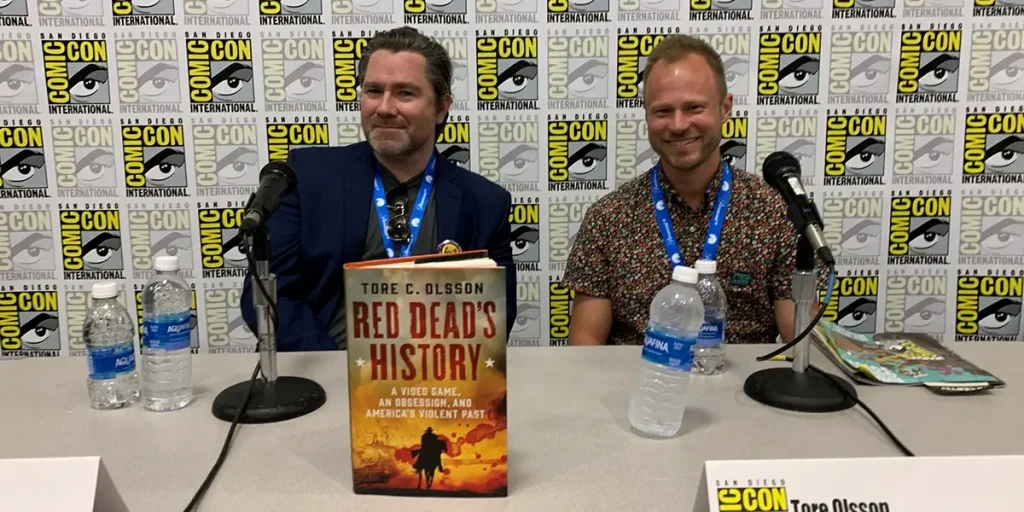
The book is already attracting national attention. Olsson and Roger Clark—who plays the lead role in Red Dead Redemption II and narrates the book’s audio edition—spoke and signed copies of the book and the game during this summer’s San Diego Comic-Con, one of the largest annual popular-culture events in the world.
“Participating as a speaker at Comic-Con was truly dreamlike,” said Olsson, associate professor and director of graduate studies in the UT Department of History. He and Clark spoke to a packed room of around 480 people during a panel session. “We answered thoughtful audience questions about college teaching, how video games can be a gateway to serious learning, and how questions of race and gender are subjects becoming more central to game narratives. Though I’ve given many public talks before, I’ve never seen a more rapt audience.”
More recently, the Wall Street Journal reviewed Red Dead’s History on the front of its book section, calling the book “innovative and highly engaging.” The Chronicle of Higher Education shared the story of how the class and the book “made history cool again.” The cable news channel C-SPAN will have a camera crew at Olsson’s book launch event at 6 p.m. Thursday, August 15, at the East Tennessee History Center. The event will also feature the premiere of the Land Grant Films documentary about his “Red Dead History” class.
Like the class that inspired it, the book examines how well the “Red Dead” games fare as recreations of history, exploring the real violence and political turbulence between 1870 and 1920, and what can be learned to understand contemporary American culture.
“Red Dead Redemption II, like most best-selling games today, places violence front and center to its entertainment formula,” said Olsson. “The America of the late 1800s was indeed a violent place—yet for different reasons than shown in the video games.
The game usually offers a stereotypical “wild west” style of competition involving violence: bullets fly during robberies, over personal grudges, or from too much whiskey.
“Real American violence was instead usually wound up with big social dilemmas,” said Olsson. “Particularly the questions of big business and its control over regular people, and whether the US would realize its post-Civil-War promise of racial equality. These were hotly contested issues, and ones that often spurred bloodshed.”
Many elements in the video game are inspired by real-world people and places. The city of Saint Denis, for example, is a stand-in for New Orleans circa 1899.
“The game does a nice job capturing the architecture and the human diversity of the city, but it falls short on many other questions,” said Olsson. “In the book, I explore the place of Italian immigrants within the city, and what it looked like when outlaws and the police traded fire. On both topics the game diverges from the reality of turn-of-the-century New Orleans.”
The book follows a similar format to Olsson’s class, looking at different geographic regions and key thematic topics within each. In “The West,” Olsson discusses cowboys, railroads, and the Pinkerton agency. In “The Deep South,” he looks at the history of the Ku Klux Klan, chain gangs, and women’s suffrage.
Olsson wanted the book to be accessible and engaging to a wide, non-academic audience and wrote it with storytelling in mind, often infusing it with his teaching persona and voice, resulting in a more conversational approach that he says might give students who took his class some “déjà vu” while reading it. Still, it gave him the chance to delve much deeper into the subjects than he could in a classroom setting.
“With the book there’s no exam at the end of the semester, so I could take more liberties in layering new information without worrying about what students could retain for an exam,” he said. “The book is in many ways even richer in content than the class.”
By Randall Brown

Tore Olsson in ‘The Conversation’: Why I turned the ‘Red Dead Redemption II’ video game into a history class on America’s violent past


Uncommon Courses is an occasional series from The Conversation U.S. highlighting unconventional approaches to teaching.
Title of course:
Red Dead’s History: Exploring America’s Violent Past Through the Hit Video Game
What prompted the idea for the course?
This course was born during the COVID-19 pandemic. Confronting the lockdowns of 2020 and uncertain months spent at home, I rekindled a high school hobby that I had neglected for two decades – video gaming.
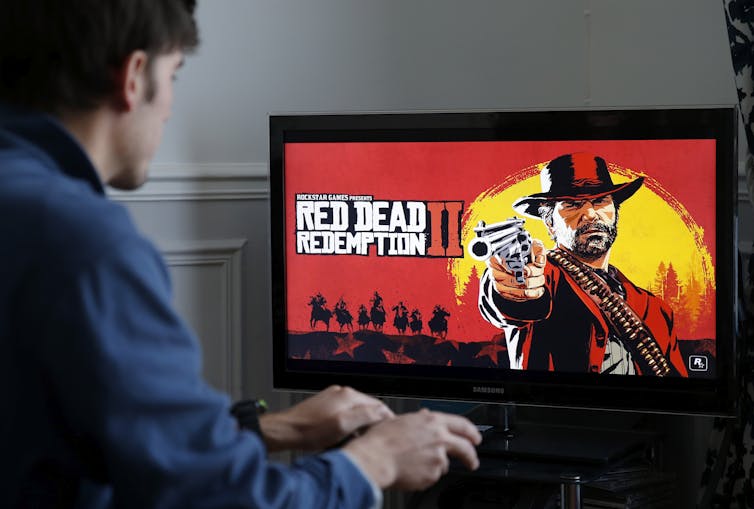
One of the first games I picked up was “Red Dead Redemption II,” set in a fictionalized America of 1899. The game follows the Van der Linde gang, a diverse crew of idealistic outlaws, as they flee authority in an increasingly ordered and hierarchical world. Since its 2018 release, the game has sold more than 64 million copies, making it the seventh on the list of all-time bestselling video games – and the only historically themed one on the list.
While video games had been a mindless pastime in high school, this time around I was playing as a professor who specialized in U.S. history since the Civil War. And though that made me a far more critical gamer, I was also genuinely surprised at how often RDRII – as it is often called – alluded to major topics that historians have spent generations debating.
These topics include corporate capitalism, settler colonialism, women’s suffrage and the inequalities of race in an era that Mark Twain had called the “Gilded Age” – a period where the dazzling wealth of a small handful sharply contrasted with the misery of common people. These weighty topics were often on the game’s sidelines, rather than at center stage – but they were present nevertheless.
It wasn’t long into my playthrough that an epiphany struck me. Given how wildly popular this game was with college-age Americans, why not try teaching a serious history course that used the fictional content of the games as a springboard to jump into some of the thorniest dilemmas of the American past?
The experiment proved a success. The course was wildly popular with students and also garnered wide media coverage for its unusual approach to teaching with pop culture.
Encouraged by this response, I’ve now adapted the course into a book for both gamers and history buffs around the world, titled “Red Dead’s History: A Video Game, An Obsession, and America’s Violent Past,” set to be released in August 2024. An extra bonus is that the audiobook version will be narrated by Roger Clark, who played RDRII’s protagonist.
What does the course explore?
Given the centrality of violence to the video game, the course seeks to understand what really spurred bloodshed in the United States between 1865 and 1920.
In RDRII, gunfire is usually sparked by personal grudges, robberies or the overconsumption of alcohol. But in Gilded Age America, it wasn’t so simple. Instead, broader social problems were the primary catalyst of violence. First, Americans fought over the emerging regime of corporate capitalism. Should new businesses like U.S. Steel and the Union Pacific Railroad, who wielded never-before-seen power and influence, dominate workers and consumers alike? Many resisted such an idea through protests, strikes and sometimes bloodshed.
Secondly, Americans came to blows over the unfulfilled promises of racial equality that were written into the U.S. Constitution after the Civil War. Especially in the South, where the vast majority of African Americans lived, the formerly enslaved and their descendants demanded inclusion in politics and a chance to progress economically. But many white Southerners resisted such efforts, often using terrorism to push their Black neighbors into subservient positions.
Why is this course relevant now?
American society in the late 19th century was ruptured by inequalities wrought by capitalism and race – and so is ours today. In the wake of Black Lives Matter and Occupy Wall Street, it’s wise that we look back at the long road that brought America to its contemporary dilemmas of racial violence and the gap between rich and poor. A handy way to open that conversation with young Americans is through video games – an industry that has now surged in value to eclipse both music and movies, and which might be the key to reaching this generation’s students, as studies are beginning to show.
What’s a critical lesson from the course?
One key lesson is about the city of New Orleans, fictionalized in RDRII as “Saint Denis.” In the game, the outlaw protagonists trade fire with the city’s blue-coated policemen following a botched bank robbery, leaving bodies in the streets. Few gamers could guess that a similarly bloody firefight with the police riveted the real city in 1900, just a year after the game is set, leaving seven officers dead. Yet here the outlaw was a Black man, Robert Charles, who took a violent stand against police abuse and the emerging system of Jim Crow segregation.
In response to his attacks on the police, white mobs roamed the city and indiscriminately killed Black civilians. Therefore, the explosion of violence in New Orleans was produced not by simple banditry but by one of America’s towering social dilemmas.
What materials does the course feature?
I frequently begin course sessions with a brief video cutscene or gameplay footage from RDRII, before we dive into the actual history that the games represent – or sometimes, misrepresent. For reading, students dive into scholarly monographs such as historian K. Stephen Prince’s “The Ballad of Robert Charles”, on the violent dilemmas of race in New Orleans. They also read a range of original sources, such as cowboy memoirs, train schedules and a Texas newspaper from 1899.
What will the course prepare students to do?
Anyone who has taken my class – or read my new book – will know that the big social problems we are wrestling with today have deep roots, and took their modern shape during the same 1865-1920 period that is memorably captured in RDRII. They’ll also become much more discerning consumers of digital media, and games in particular; they’ll be better able to assess and critique representations of history on the digital screen.
Tore Olsson, Associate Professor of History, University of Tennessee
This article is republished from The Conversation under a Creative Commons license. Read the original article.
Summer 2024 Newsletter
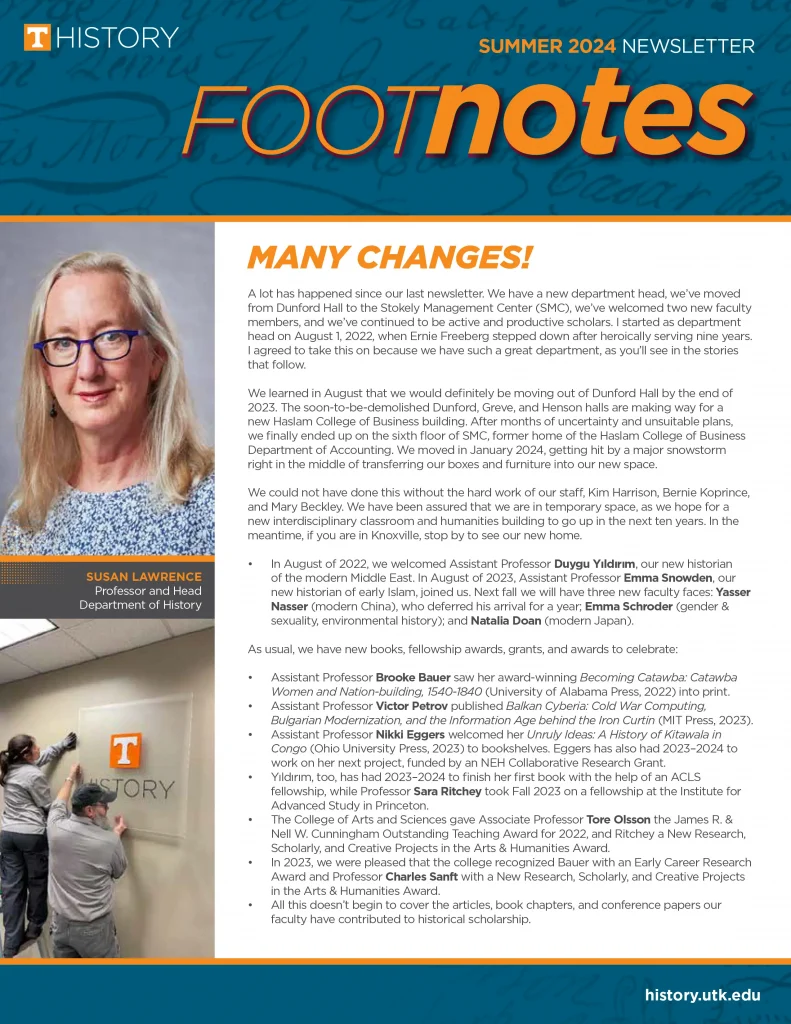
- Many Changes! – Message from the Department Head
- Eggers Chronicles Congo Refugee Experience
- Bauer Research Earns Awards
- Graduate Program Notes
- Undergraduate Update: A Vibrant History Club
- History Students Pursue Honors Research
- Public History Class at Baker Center
- Yıldırım Book Project Supported Through Fellowship
- Emma Snowden Wins Research Fellowship
- Professor Jeff Norrell Retires
- Remembering Professor Bruce Wheeler (1939-2023)
- UT History Department Documents Key Year in Andrew Jackson’s Presidency
UT History Department Documents Key Year in Andrew Jackson’s Presidency
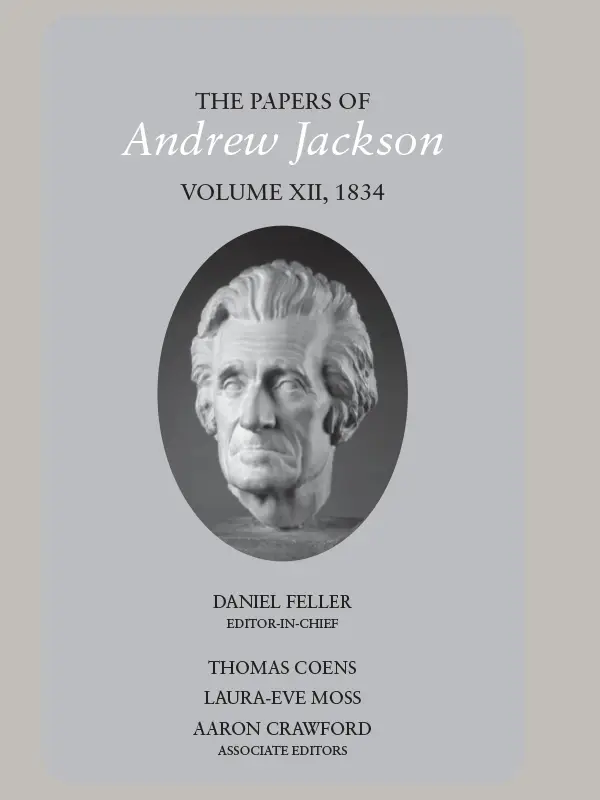
In partnership with UT Press, the UT history department published the 1834 volume of The Papers of Andrew Jackson in December 2023. Documenting in rich detail one of the most important years of Jackson’s presidency, the volume covers Jackson’s “war” against the Bank of the United States, as well as his administration’s infamous program to force the removal of Native Americans from their homelands in the Southeast.
In 1834 Jackson continued his longstanding effort to pry the province of Texas loose from Mexico. Other matters engaging Jackson included corruption scandals in the Post Office and at Mississippi land offices, fractious disputes over rank and seniority among Army and Navy officers, and a fire that gutted Jackson’s home in Tennessee, the Hermitage.
These stories and many more are told in The Papers of Andrew Jackson: Volume XII, 1834. Presenting more than 500 original documents—public and private letters, memoranda, and official papers—in full annotated text, the volume is the latest installment in an ongoing series that has been called “the gold standard of historical documentary editing.”
Volume XII is the sixth and last produced under the editorship of Daniel Feller, now a UT Distinguished Professor Emeritus. Associate editors Thomas Coens and Laura-Eve Moss are UT research faculty in history. The index was completed under Michael Woods, Feller’s successor as UT history professor and Jackson editor. Financial support was provided by the UT College of Arts and Sciences, the National Endowment for the Humanities, the National Historical Publications and Records Commission, the Tennessee Historical Commission, and the Watson-Brown Foundation.
Remembering Professor Bruce Wheeler (1939-2023)

On Tuesday, April 9, the UT Department of History and the Knoxville History Project collaborated on an event to honor the late Professor Bruce Wheeler. Wheeler joined the department in 1970 and served the UT Knoxville campus and community for over four decades.
“No list of accomplishments can fully convey all that Bruce Wheeler meant to the UT campus and the history department,” colleague Ernest Freeberg wrote in a memorial tribute. “He will be remembered for his ability to share his love of history with a wide audience, his never-failing curiosity and good humor, and his generous support of his younger colleagues and our students.”
The program’s speakers recognized Wheeler’s many and varied accomplishments. He was a distinguished historian who wrote an important history of Knoxville; he was an engaging and innovative teacher beloved by a generation of UT students; and he generously contributed his time to help improve history education in East Tennessee public schools. During his long career, he was recognized with numerous teaching awards, and served as the head of the University’s Honors Program before his retirement in 2003.
As Aaron Purcell, one of his last doctoral students, noted, “Wheeler made a difference in the lives of countless students and I’m proud to say that I was one of them.”
Professor Jeff Norrell Retires
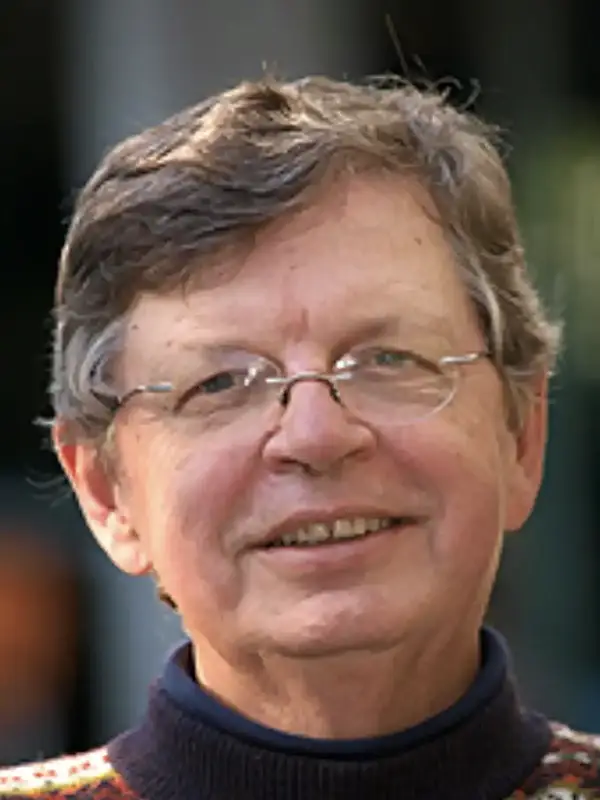
Professor Jeff Norrell retired in January 2024 after holding the Bernadotte Schmitt Chair of Excellence since joining the department in 1998. He is the author of more than a dozen books, primarily on American race relations and Southern history.
These include Alex Haley and the Books that Changed a Nation (2015), which covers Haley’s rise to national celebrity and great literary influence in the mid-20th century. In 2009, the Washington Post called his revisionist biography, Up from History: the Life of Booker T. Washington, one of the best books published that year, “in all respects an exemplary book, scrupulously fair to its subject and thus to the reader as well.”
His 1985 book, Reaping the Whirlwind: The Civil Rights Movement in Tuskegee, won the Robert F. Kennedy Book Award for outstanding work on human rights and social justice. In addition to his many works of history, he published Eden Rise (2012), a novel about the civil rights movement.
In addition to courses on Southern history, Norrell taught undergraduate and graduate classes on environmental history, the history of the American West, and American foreign policy. He recently published How History Was Used in the Wars of the Twentieth Century: Perpetual War for Perpetual Peace (Lexington, 2023).
In 2010 he was Fulbright Distinguished Chair in American Studies in Germany, and in 2015 the College of Arts and Sciences presented him with a Senior Research Award.
Emma Snowden Wins Research Fellowship

Emma Snowden has been awarded a Kingdon Fellowship at the Institute for Research in the Humanities at the University of Wisconsin-Madison, where she will be in the 2024–20255 academic year. On the UT history faculty since 2023, Snowden researches the history of the medieval Mediterranean, focusing on Iberia and North Africa. She is currently working on her first monograph, Narrating Conquest and Colonization in the Medieval Western Mediterranean. This book project draws on Arabic, Latin, and Romance chronicles from the eighth through the 14th centuries to examine how Muslims and Christians narrated political and religious conflict, exploring the extent to which writers across the Strait of Gibraltar viewed their history as a shared one and wrote within a common historical framework.
Yıldırım Book Project Supported Through Fellowship

Assistant Professor Duygu Yıldırım was awarded a 2023 ACLS Fellowship from the American Council of Learned Societies (ACLS) in support of her book project, Uncertain Knowledge: The Making of Slow Science between the Ottoman Empire and Early Modern Europe.
The ACLS Fellowship Program supports exceptional scholarship in the humanities and interpretive social sciences that has the potential to make significant contributions within and beyond the awardees’ fields. Yıldırım is one of 60 early-career scholars from around the country who were selected through a multi-stage peer review from a pool of nearly 1,200 applicants.
Yıldırım’s work explores the role of uncertainty during the globalization of scientific and medical knowledge in the late seventeenth and early eighteenth centuries. Her book project will show how the rhetoric of uncertainty became a new mode of inquiry and a highly productive new strategy to accommodate emerging anxieties about human diversity, confessional and inter-religious conflict, and the fragmentary knowledge of newly circulated medicinal substances and plants.
Public History Class at Baker Center
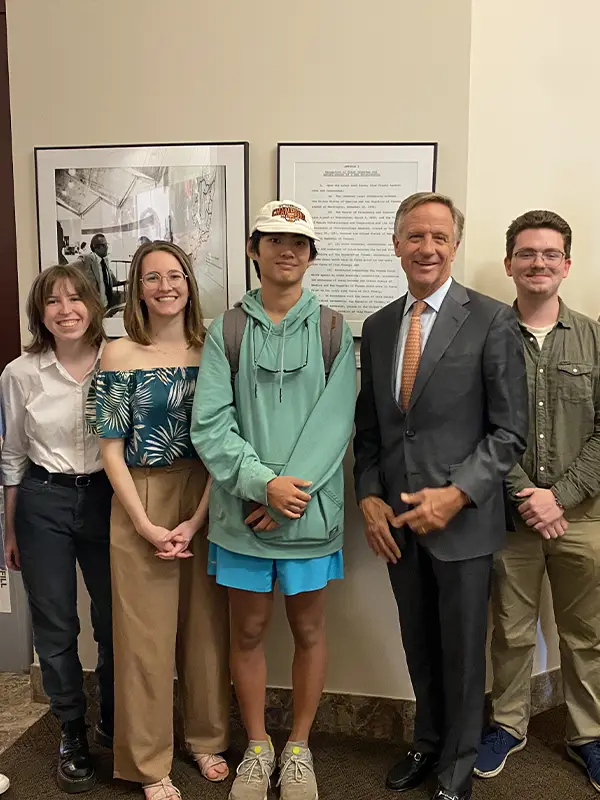
Distinguished Lecturer Pat Rutenberg’s HIUS 484 class produced an exhibit for the official opening of the Baker School for Public Policy and Public Affairs titled “Senator Howard H. Baker Jr., The Great Conciliator.”
Undergraduate students in our upper-level course on public history recently curated an exhibition for the dedication ceremony at the new Baker School of Public Policy and Public Affairs. Rutenberg’s public history course addresses recent scholarly and public conversations about memory and monuments, provides supervised internships for each student at local historical sites and organizations, and engages students in group capstone projects.
For the Baker School exhibition, students conducted research in the Howard Baker Archives and UT Special Collections, identified photographs and documents depicting significant moments in the public life of Senator Baker, and wrote detailed exhibition labels. At the dedication ceremony, the students were pleased to have their picture taken with former Governor Bill Haslam.
- « Previous Page
- 1
- 2
- 3
- 4
- 5
- …
- 7
- Next Page »