• Request More Info
  • Visit
  • Apply
  • Give
  • Request More Info
  • Visit
  • Apply
  • Give

Search

  • A-Z Index
  • Map

History

  • About
    • Why Study History?
    • Areas of Study
    • Faculty Publications
    • The Jangle Podcast
    • Alumni Profiles
    • Contact Us
    • Give
  • People
    • Faculty
    • Teaching Faculty
    • Research Faculty
    • Associated Faculty
    • Staff
    • Graduate Students
    • Emeriti
  • Undergraduate
    • Majors / Minors
    • Declare
    • Honors Program
    • Advising
    • Classes
    • Beyond the Classroom
    • Careers
    • Scholarships & Awards
  • Graduate
    • Concentrations
    • MA Program
    • PhD Program
    • Apply
    • Funding
    • Forms
    • Graduate Handbook
  • Community Engagement
    • Local Histories
    • Summer Bridge Program
    • Bridge to AP U.S. History
    • Papers of Andrew Jackson
    • Tennesseans and War
  • News & Events
    • News
    • Events
    • Public Lecture Series
    • Newsletters
  • Share Your News
topography background

News

Archives

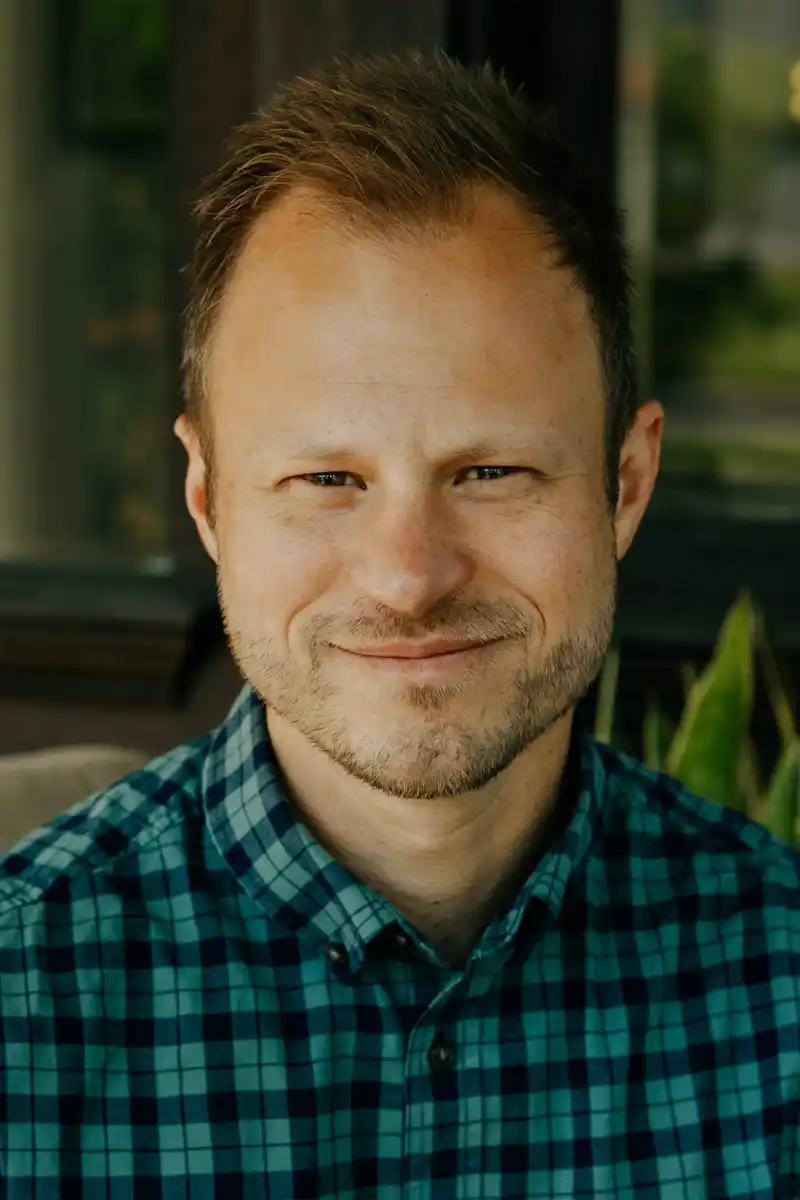
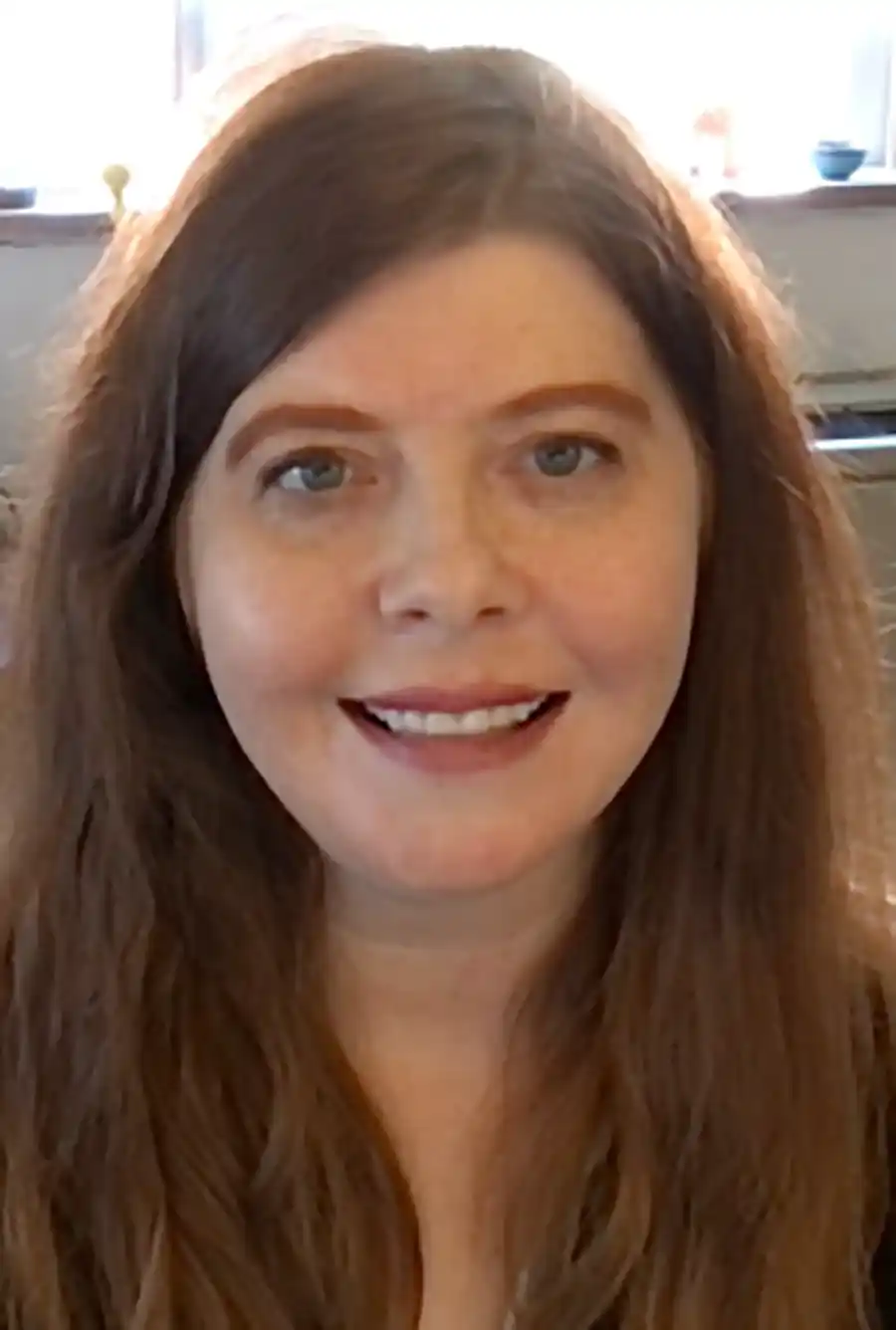
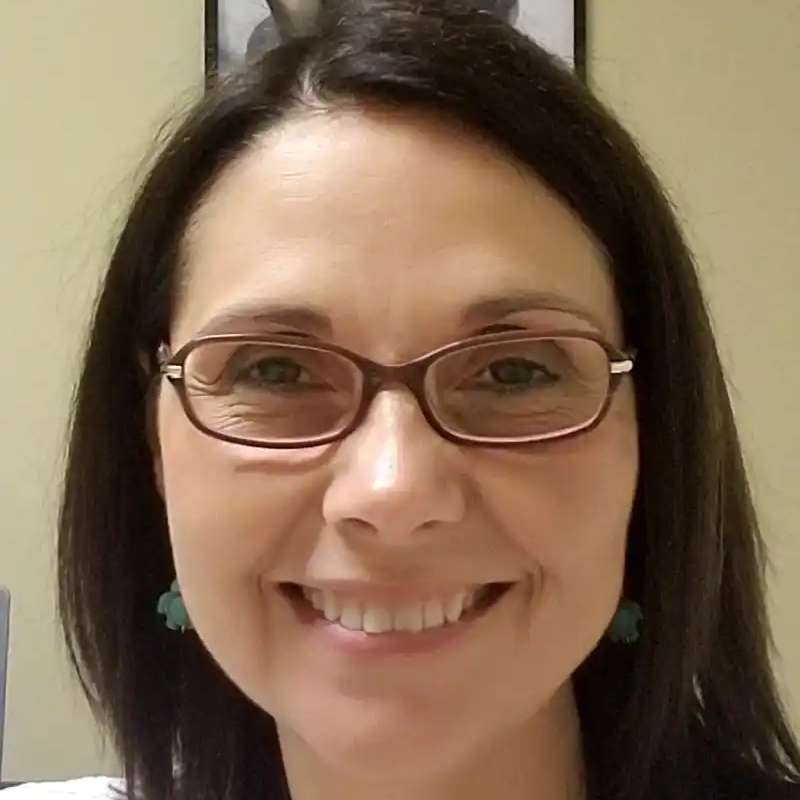
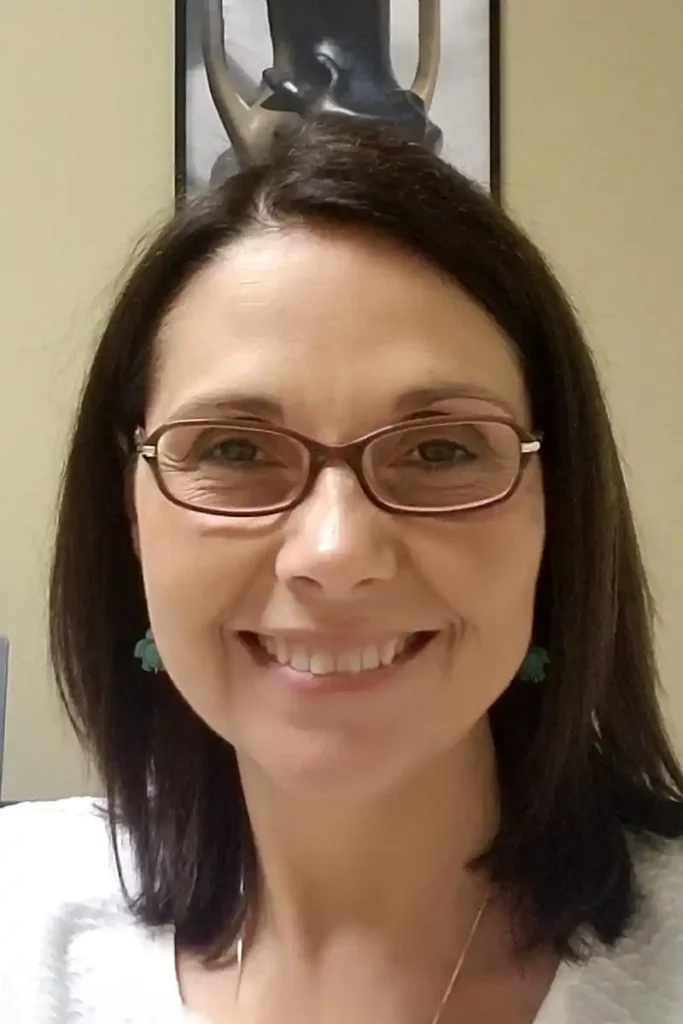
Photo of Brooke Bauer

Bauer’s ‘Becoming Catawba’ Earns Best Ethnohistory Award
January 4, 2024

Brooke Bauer

Brooke Bauer, assistant professor in the Department of History, received the 2023 Erminie Wheeler-Voegelin Book Award from the American Society for Ethnohistory (ASE) for her book, Becoming Catawba: Catawba Indian Women and Nation Building, 1540-1840 (2023).

The award recognizes the best book in the field of ethnohistory published in the last year. Bauer’s work investigates Catawba women as central characters in the history of the Catawba people, examining their vital roles as women, mothers, providers, and protectors to reveal how they created and maintained an identity for their people and helped build a nation.

In citing the book’s award-winning qualities, the ASE wrote, “Bauer constructs a riveting narrative about how the communities, economies, families, and polities of Catawbas in the Carolinas became intricately entwined and maintained over three centuries of turmoil brought about by European and US colonialism. In so doing, she crafts not only a powerful counter narrative to male-dominated stories of colonial diplomacy and warfare, but also a narrative of national creation and building rather than one of decline.”

ASE also noted Bauer’s careful research, interdisciplinary source-mining, and convincing arguments forged an “entirely engaging” story, writing, “Bauer shows how to combine family research with archaeological and documentary research with huge rewards for specialists and non-specialists alike.”

Bauer’s award-winning exploration of this regional history exemplifies the Volunteer connection to community, illuminating the past to understand our world today.

Filed Under: News

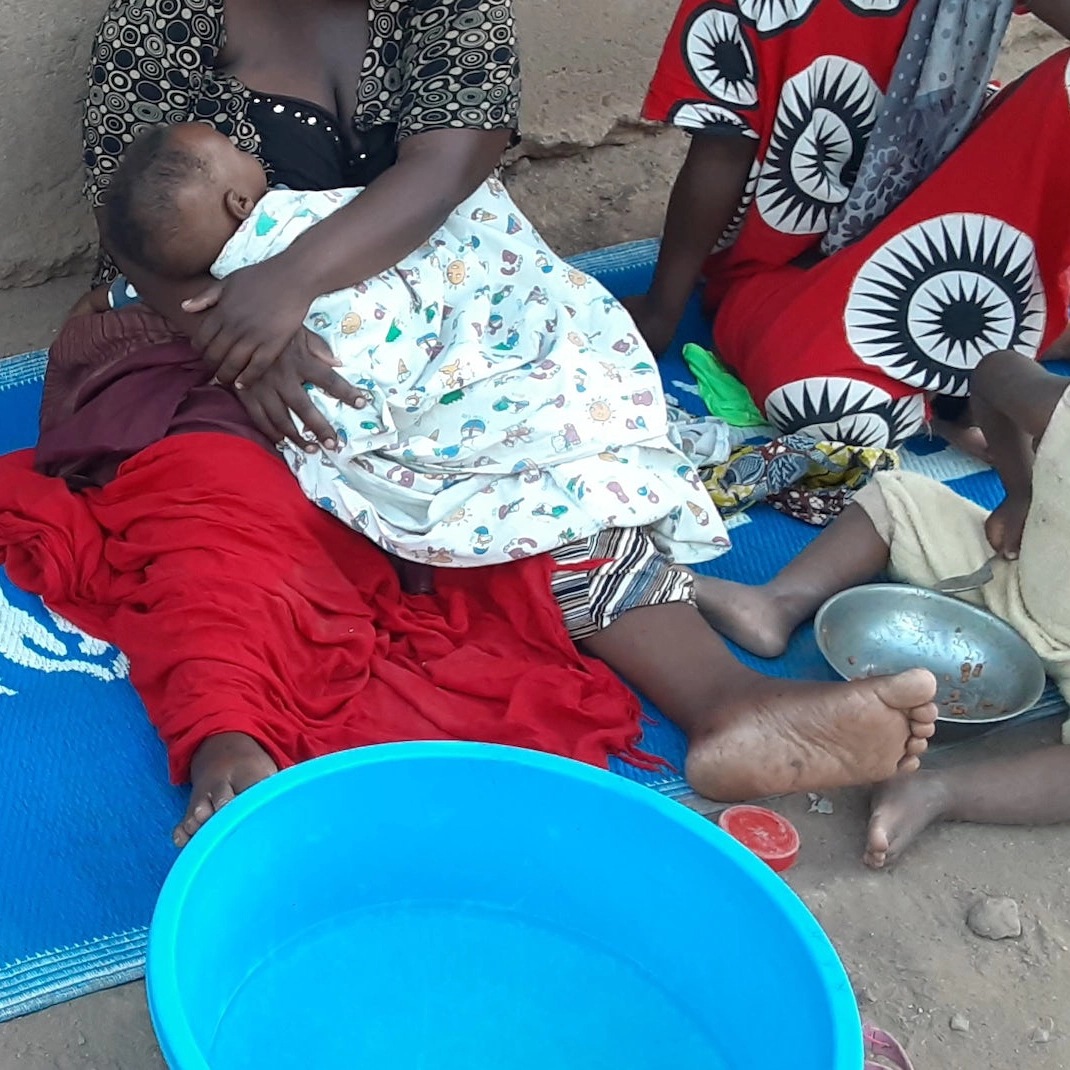
Empty bowls at a refugee camp in Kenya. Author provided

Nicole Eggers Published in ‘The Conversation’

December 14, 2023

‘You reach a point where you have nothing. You will just die’ – in East African refugee camps, food scarcity is a mortal concern

Empty bowls at a refugee camp in Kenya. Author provided
Roger B. Alfani, Seton Hall University and Nicole Eggers, University of Tennessee

For refugees living in settlements across Africa, life got more difficult in 2023.

Shortfalls in the operating budget of the United Nations refugee agency, UNHCR, and the World Food Program have brought increased precarity into the daily lives of millions of displaced people across the continent.

Having fled violence, famine and insecurity in search of survival, many African refugees now find themselves faced with similar circumstances in the very spaces designed to protect them. Most notably, over the past year, refugees in Central and East Africa have watched as their food rations and living stipends – already meager – have been cut to unsustainably low levels.

In Africa’s largest refugee-hosting country, Uganda, the budget for UNHCR programs is currently funded at only 39% of its needs. Burundi, which has experienced a 35% increase in its refugee population since 2018, as well as a large increase in the number of returned Burundian refugees, has seen its own budget increase by only 12% in that same period.

The reasons for these shortfalls are multifaceted, including the lasting effects of the COVID-19 pandemic and the Russia-Ukraine war, which has affected food production and resulted in an increase of prices. Though refugees themselves say they are offered little explanation – “They just tell us that the order came from Geneva,” one refugee told us in reference to UNHCR’s headquarters in the Swiss capital.

The resulting cuts in food security programs have had devastating effects on refugee families and communities.

We spent three months in Africa this past summer interviewing over 200 refugees across seven refugee camps and urban refugee havens in Burundi, Uganda and Kenya. While we were there to primarily investigate the role of faith and religious community among refugees from the Democratic Republic of Congo, our interviews touched on many aspects of the refugee experience. All names used in this article have been changed to protect the interviewees identity.

‘Just not enough’

Cuts in food rations were on the minds of nearly all of the refugees whom we interviewed this summer.

In Burundi, for example, a number of refugees explained to us how 2023’s rations for their daily dietary staple – cornflour used to make a hard porridge known locally as “bukari” – had been cut from 10 kilograms (22 pounds) per month to three kilograms (6.6 pounds). One refugee in the Bwagiriza refugee settlement in Burundi, Jean-Claude, explained how if you try to divide that amount of food into 30 piles, one for each day, it’s “just not enough.” Ultimately, he said, “You worry because you have no idea how you will finish the month. Little by little, the quantity of food goes down at home.”

Stories like Jean Claude’s offer a glimpse of the psychological stress that refugees experience daily as they engage in an unending search for enough food to feed their families – a search that too frequently fails.

To make matters worse, rising inflation has meant that the ability of refugees to draw on whatever modest resources they may possess to supplement their diets has been greatly undermined.

For parents, this leads to further trauma of explaining to their hungry children that there will be no food. One young mother in the Rwamwanja refugee settlement in Uganda told us how, in a desperate ploy to delay disappointment, she put an empty pot of water on the stove to boil just so that her children would go to bed with the hope that there would be food to eat in the morning.

Hunger and exploitation

Others resort to even more desperate ends, consuming inedible food that can sicken and even kill them.

“Whole families become sick. Some neighbors ate some roots because of hunger. All of them were vomiting,” a refugee mother named Mauwa explained to us in Burundi. “Mother, father, children … we are forced to eat food that doesn’t agree with us and makes us sick to our stomachs.”

Still others face the worst outcome imaginable.

Amina, a Congolese refugee living in Bwagiriza, described how, following days of not eating, her young child became violently ill after consuming some corn porridge, her severely malnourished body no longer able to digest it. The child’s condition should have been treatable, but because budget cuts had also recently ended medical transport assistance, they were unable to get to the hospital quickly enough and ultimately the child died.

“There is no food. There is no health care,” she said. “We are being trampled. You reach a point where you have nothing. You will just die.”

Other refugees emphasized how ration cuts contribute directly and indirectly to heightening insecurity in the settlements.

“Famine in the camp is torturing us,” said Amani, a father of seven. “Lack of food is causing our children to become thieves. The moment it is dusk, they break into homes seeking the food they saw you bringing into the house. They don’t look for anything else – just food.”

Refugees in Kyaka II and other settlements in Uganda described being exploited by local communities and how women and youths were exposed to sexual violence.

Vumilia, a mother from a Burundian camp, explained how young girls, including her own, were sexually exploited by adults in return for food: “These camps are harming our children. A child as young as 12 is getting pregnant. And it’s because of hunger that she is forced to consent so that she can get some food … and she is raped and she gets pregnant.”

Refugees also observed that ration cuts and food scarcity threaten to turn cordial relationships with local communities into ones defined by conflict.

“We will now be fighting with the [Ugandan host communities] and each other,” explained Furah, a Congolese woman in one of the Ugandan camps, “because you have brought insecurity in the camp. … This will then lead to conflicts. If they don’t kill me, I will kill them.”

What chance self-reliance?

In response to these cuts, the UNHCR is increasingly promoting self-reliance programs, but ration cuts undermine such programs.

Refugees are told that they must learn to depend on themselves and are taught various skills such as gardening, weaving and animal husbandry. But the strain on their resources leaves them unable to invest.

Marceline in the Kavumu settlement explained, “On this question of self-reliance, you ask yourself: With what resources are you supposed to become self-reliant? … If you’re going to tell someone to be self-reliant, you have to give them the materials to start with.”

We’ve seen that refugees work hard to help themselves and each other. But when resources are so minimal, it is impossible for them to bear the burden themselves.

Time and again, we’ve found that refugees are keen observers of the world around them and they can offer critical insight into the conditions that have been created on the ground, particularly in this context of increasing ration cuts. Listening to them reminds us that behind every budget cut is a human story.The Conversation

Roger B. Alfani, Core Fellow of Religious Studies and International Affairs, Seton Hall University and Nicole Eggers, Assistant Professor of History, University of Tennessee

This article is republished from The Conversation under a Creative Commons license. Read the original article.

Filed Under: News

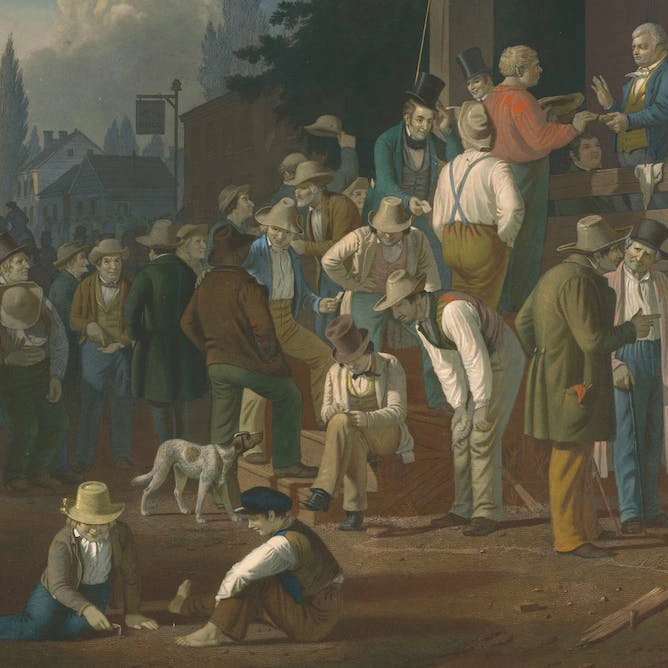
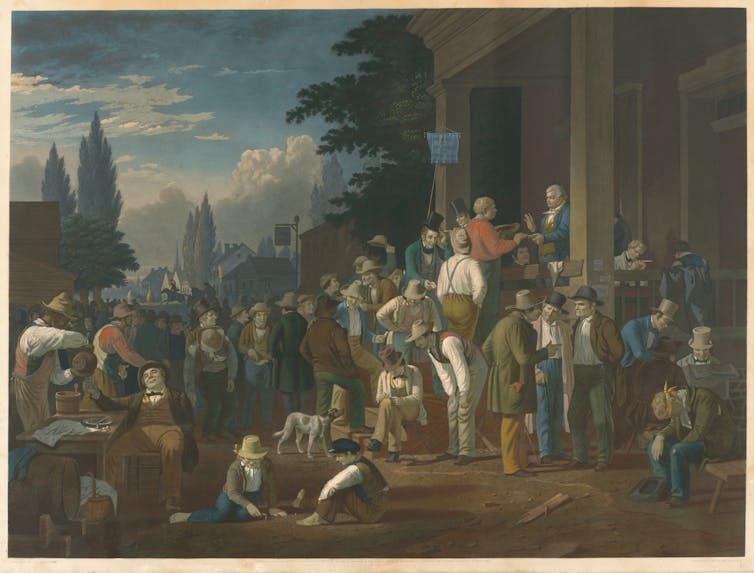
Voters in a county election, 1854. Etching by John Sartain after painting by George Caleb Bingham; National Gallery of Art

Thomas Coens Published in ‘The Conversation’

December 7, 2023

Why Franklin, Washington and Lincoln considered American democracy an ‘experiment’ – and were unsure if it would survive

Voters in a county election, 1854. Etching by John Sartain after painting by George Caleb Bingham; National Gallery of Art
Thomas Coens, University of Tennessee

From the time of the founding era to the present day, one of the more common things said about American democracy is that it is an “experiment.”

Most people can readily intuit what the term is meant to convey, but it is still a phrase that is bandied about more often than it is explained or analyzed.

Is American democracy an “experiment” in the bubbling-beakers-in-a-laboratory sense of the word? If so, what is the experiment attempting to prove, and how will we know if and when it has succeeded?

Establishing, then keeping, the republic

To the extent you can generalize about such a diverse group, the founders meant two things, I would argue, by calling self-government an “experiment.”

First, they saw their work as an experimental attempt to apply principles derived from science and the study of history to the management of political relations. As the founder John Jay explained to a New York grand jury in 1777, Americans, acting under “the guidance of reason and experience,” were among “the first people whom heaven has favored with an opportunity of deliberating upon, and choosing the forms of government under which they should live.”

Alongside this optimistic, Enlightenment-inspired understanding of the democratic experiment, however, was another that was decidedly more pessimistic.

Their work, the founders believed, was also an experiment because, as everyone who had read their Aristotle and Cicero and studied ancient history knew, republics – in which political power rests with the people and their representatives – and democracies were historically rare and acutely susceptible to subversion. That subversion came both from within – from decadence, the sapping of public virtue and demagoguery – as well as from monarchies and other enemies abroad.

When asked whether the federal constitution of 1787 established a monarchy or a republic, Benjamin Franklin is famously said to have answered: “A republic, if you can keep it.” His point was that establishing a republic on paper was easy and preserving it the hard part.

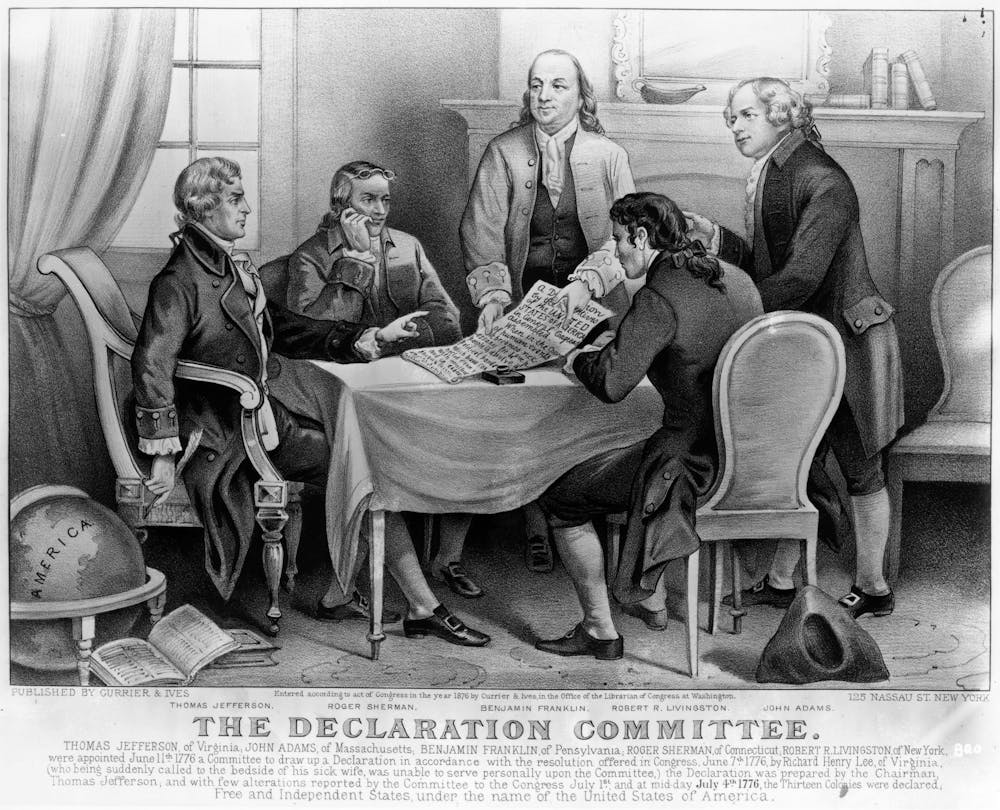
Five men sitting and standing around a table, with the title 'The Declaration Committee' below the image.
The committee that drafted the Declaration of Independence, from left: Thomas Jefferson, Roger Sherman, Benjamin Franklin, Robert R. Livingston and John Adams. Printed by Currier & Ives; photo by MPI/Getty Images

Optimism and pessimism

The term “experiment” does not appear in any of the nation’s founding documents, but it has nevertheless enjoyed a privileged place in public political rhetoric.

George Washington, in his first inaugural address, described the “republican model of government” as an “experiment entrusted to the hands of the American people.”

Gradually, presidents began to talk less of a democratic experiment whose success was still in doubt than about one whose viability had been proven by the passage of time.

Andrew Jackson, for one, in his 1837 farewell address felt justified in proclaiming, “Our Constitution is no longer a doubtful experiment, and at the end of nearly half a century we find that it has preserved unimpaired the liberties of the people.”

Such statements of guarded optimism about the American experiment’s accomplishments, however, existed alongside persistent expressions of concern about its health and prospects.

In the period before the Civil War, despite participating in what in hindsight was a healthy, two-party system, politicians were forever proclaiming the end of the republic and casting opponents as threats to democracy. Most of those fears can be written off as hyperbole or attempts to demonize rivals. Some, of course, were sparked by genuine challenges to democratic institutions.

The attempt of Southern states to dissolve the Union represented one such occasion. In a July 4, 1861, address to Congress, Abraham Lincoln quite rightly saw the crisis as a grave trial for the democratic experiment to survive.

“Our popular Government has often been called an experiment,” Lincoln observed. “Two points in it our people have already settled – the successful establishing and the successful administering of it. One still remains – its successful maintenance against a formidable internal attempt to overthrow it.”

Vigilance required

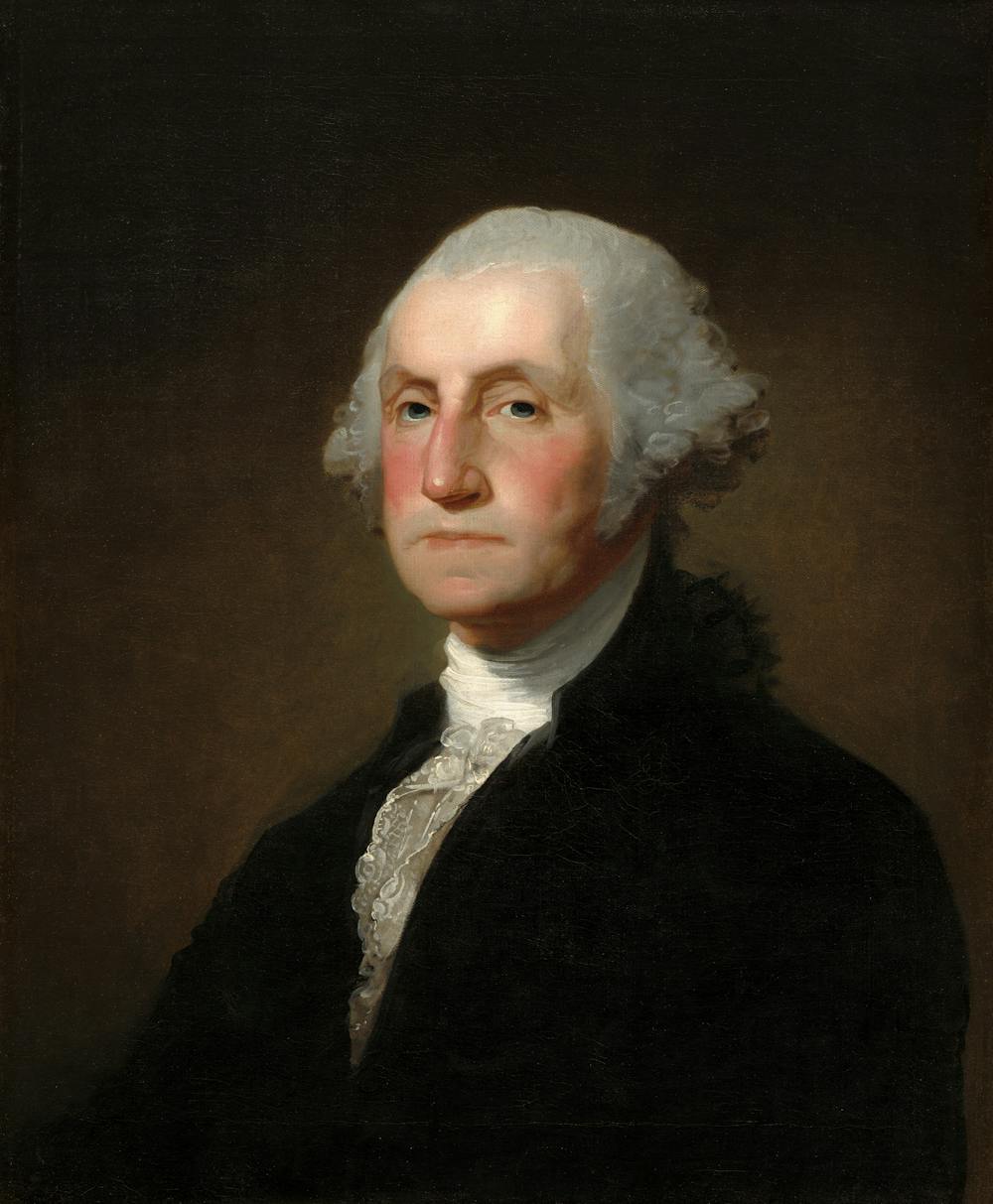
An white haired man from the 18th century in a black coat and white shirt with high collar.
George Washington, in his first inaugural address, described the ‘republican model of government’ as an ‘experiment entrusted to the hands of the American people.’ National Gallery, Corcoran collection

If you tried to quantify references to the democratic “experiment” throughout American history, you would find, I suspect, more pessimistic than optimistic invocations, more fears that the experiment is at imminent risk of failing than standpat complacency that it has succeeded.

Consider, for example, the popularity of such recent tomes as “How Democracies Die,” by political scientists Steven Levitsky and Daniel Ziblatt, and “Twilight of Democracy,” by journalist and historian Anne Applebaum. Why this persistence of pessimism? Historians of the United States have long noted the popularity since the time of the Puritans of so-called “Jeremiads” and “declension narratives” – or, to put it more colloquially, nostalgia for the good old days and the belief that society is going to hell in a handbasket.

The human-made nature of our institutions has always been a source of both hope and anxiety. Hope that America could break the shackles of old-world oppression and make the world anew; anxiety that the improvisational nature of democracy leaves it vulnerable to anarchy and subversion.

American democracy has faced genuine, sometimes existential threats. Though its attribution to Thomas Jefferson is apparently apocryphal, the adage that the price of liberty is eternal vigilance is justly celebrated.

The hard truth is that the “experiment” of American democracy will never be finished so long as the promise of equality and liberty for all remains anywhere unfulfilled.

The temptation to give in to despair or paranoia in the face of the experiment’s open-endedness is understandable. But fears about its fragility should be tempered with a recognition that democracy’s essential and demonstrated malleability – its capacity for adaptation, improvement and expanding inclusivity – can be and has historically been a source of strength and resilience as well as vulnerability.The Conversation

Thomas Coens, Research Associate Professor of History, University of Tennessee

This article is republished from The Conversation under a Creative Commons license. Read the original article.

Filed Under: News

Tore Olsson

Prestigious American Historical Review Showcases UT Class Where Video Games Meet History

December 7, 2023

Tore Olsson

Tore Olsson put his students in touch with American history through his popular and award-winning class “Red Dead America: Exploring America’s Violent Past Through the Hit Video Games.” Now this engagement has reached beyond the classroom—the historical profession’s most prestigious journal, the American Historical Review, just published a major feature on the class as an example of creative and innovative history teaching.

Olsson is an associate professor and director of graduate studies in UT’s Department of History. His focus as a historian is the United States since the Civil War, with a particular interest in the US South, rural history, and transnational history. His December 2023 AHR article, “Teaching History with Video Games,” explores his inspiration to channel this focus into a college course. While playing the video game Red Dead Redemption II during the pandemic, he realized that he could apply interest in the wildly popular game toward teaching the real US history.

“My epiphany, therefore, was simple,” wrote Olsson. “Why not try teaching an undergraduate class that uses the fictional content of the game as a gateway to exploring some of the thorniest dilemmas that wracked the United States between the 1870s and 1920s?”

A February 2021 social media post announcing the new course went viral. By August of the same year, the class launched with 60 students—double the usual size for such a class. His innovative success with the class earned him a James R. and Nell W. Cunningham Outstanding Teaching Award at the College of Arts and Sciences Annual Awards Banquet in February 2023.

Olsson’s American Historical Review article details how his class examines the American history presented in the game with assigned readings and written assignments exploring the varied historical contexts, chronology, and repercussions of historical events.

“It was a tremendous honor and thrill to be invited by the AHR’s editor to write about my class in the pages of the journal,” said Olsson. “This is a big affirmation from the academy that what’s going on at UT is the most ground-breaking teaching and research work in the profession.”

Olsson enjoyed the class so much that he wrote a book based on it aimed at a wider audience of video gamers and history buffs. Red Dead’s History: A Video Game, An Obsession, and America’s Violent Past, to be published by St. Martin’s Press in August 2024. It examines how well the game’s scenarios fare as recreations of history, exploring the real violence and political turbulence between 1870 and 1920, and what can be learned to understand contemporary American culture.

Olsson teaches the course (HIUS 310) again in spring 2024—with a few seats still available for curious undergraduate Vols.

Read Olsson’s article in American Historical Review.

Filed Under: News

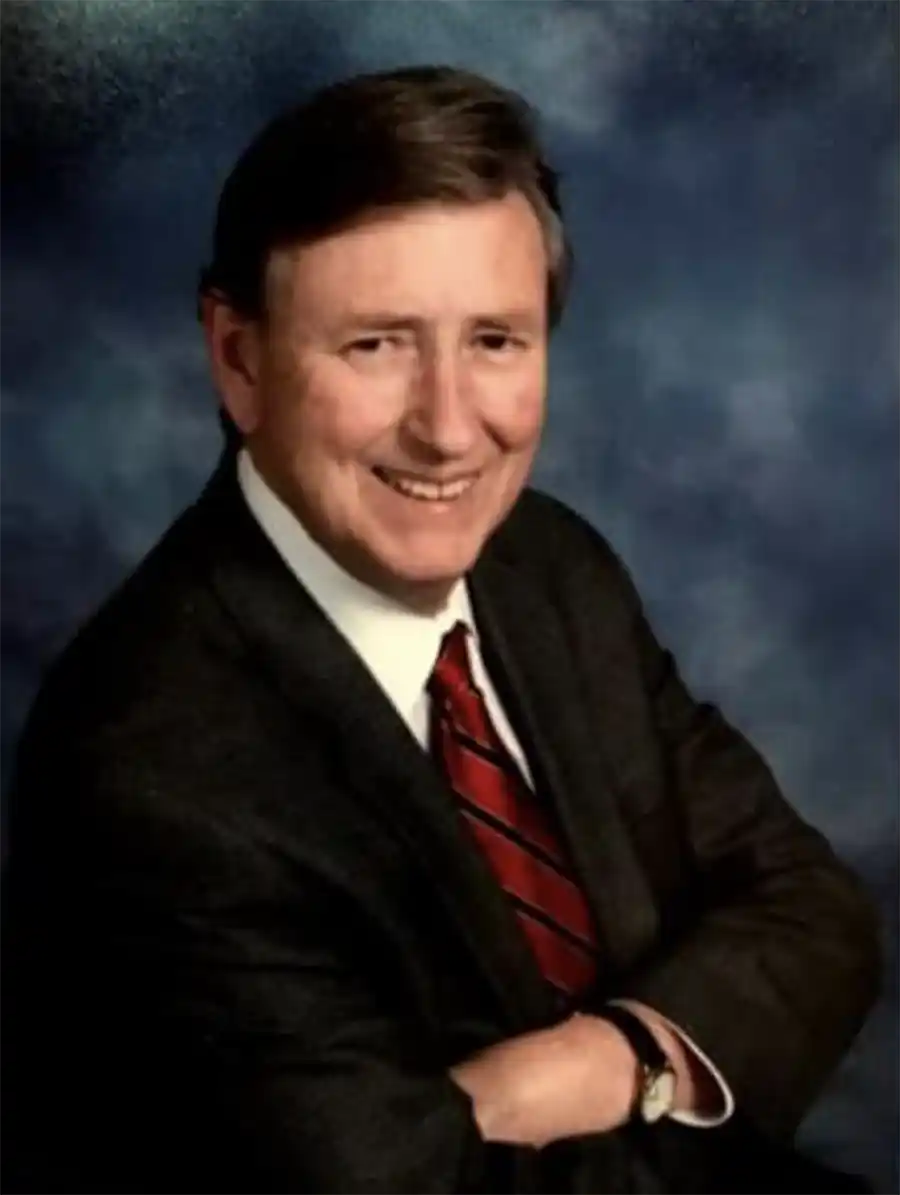
Bruce Wheeler

Remembering Professor Bruce Wheeler

November 14, 2023

Bruce Wheeler

The UT Department of History regrets to announce the death of Bruce Wheeler. Wheeler joined our department in 1970 and served our campus and community for more than four decades. He is remembered by his colleagues as a fine scholar and generous mentor; by thousands of UT students as an engaging and innovative teacher; and in the community for his outstanding service to his fellow citizens. During his long career, he was recognized with numerous teaching awards and served as the head of the University’s Honors Program before his retirement in 2003.

Wheeler received his PhD from the University of Virginia in 1967, specializing in the era of the American Revolution. He taught courses and delivered countless public lectures on the nation’s founding and developed a second research interest in Appalachian history. As a scholar and public speaker, one of Wheeler’s greatest contributions came as an articulate champion for downtown revitalization and progressive improvement in the city of Knoxville. In 1983, he published the first of three editions on the city’s history, Knoxville, Tennessee: Continuity and Change in an Appalachian City (co-written with his fellow history professor Michael McDonald). The book appeared just as the city faced the demoralizing shock of a banking scandal following the end of the 1982 World’s Fair, a collapse that cast doubt on the city’s hopes for downtown revival. Wheeler’s book challenged city leaders to overcome a “collective mentality” of “isolation, poverty, and fear of change.” In subsequent updates of this book, and in many public talks, he helped Knoxville residents to reflect on the city’s past and chart a better future. In 2020, he concluded the final edition of this book by claiming that, in spite of ongoing challenges, Knoxville had become “a city of which its residents can be truly proud.” Through his engaged public scholarship, Wheeler both documented and championed these improvements.

For a generation of UT students, Wheeler will be best remembered as a devoted and creative teacher. As one of his former students noted upon his retirement, he “epitomizes the teacher we all had at some point in our lives who had such a profound effect on us that he or she shaped the way we view the world.” Students loved his interesting and entertaining lectures, and he was an early advocate for teaching history in ways that led them to engage directly with the historical sources and generate their own conclusions. Starting in the 1980s, he shared this approach in a textbook series, Discovering the American Past, that was widely adopted in college courses nationwide.

Cover of a book about Knoxville by Bruce Wheeler

Wheeler not only excelled in his own classroom but improved history education in the region’s public schools through active engagement with East Tennessee teachers, many of them his former UT students. While serving as interim head of the Department of History, he worked with Lisa Oakley, then education director at the East Tennessee Historical Society, on a teacher training partnership that continues today.

“His approachable and personable method of teaching, peppered with his well-known wit, made him a favorite among our teachers,” she recalls. ”He claimed many as friends, even volunteering to teach in their elementary classrooms to learn more about teaching 4th and 5th graders. For me personally, Dr. Wheeler was the college professor that set me on the path toward public history. I believe I can speak for all the teachers we served together when I say that we were not only educated but inspired and motivated by Dr. Wheeler in ways that we continue to see in our lives and work today.”

Wheeler enjoyed an active retirement after 2003. In addition to revising his history of Knoxville, he served as the university’s historian. In this, he was a notable defender of academic freedom. Too often in the university’s past, he wrote, “leaders… were terrified of reactions by legislators of what was going on in the classrooms, residence halls, and even off-campus social clubs, for those leaders knew that, like Oliver Twist, they would have to journey to their respective state capitals to plead for just a few more spoonfuls. To be sure, there were courageous leaders who sought to protect their institutions from attacks on intellectual freedom, but those brave men and women were a rarity.”

No list of accomplishments can fully convey all that Bruce Wheeler meant to the UT campus and the history department. He will be remembered for his ability to share his love of history with a wide audience, his never-failing curiosity and good humor, and his generous support of his younger colleagues and our students.

When Wheeler retired, the department established a scholarship fund in his honor, used to provide graduate students with much needed financial support for their research. Donations in memoriam can be made online here or sent to the University of Tennessee Department of History, 915 Volunteer Boulevard, 6th floor Dunford Hall, Knoxville TN 37996. Please write ‘Wheeler Graduate Research Fund’ in the Notes area. 

A full obituary and funeral arrangements can be found on the KnoxNews website.

Filed Under: News

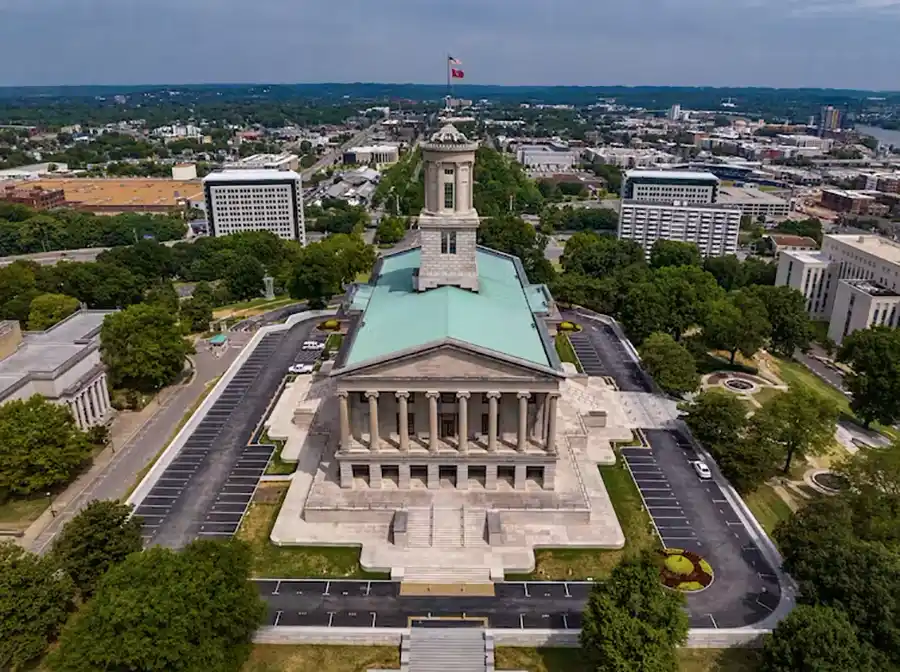
Tennessee State Capitol

White Tennessee lawmakers speak out for insurrection in honoring Confederate history

May 11, 2023

Tennessee State Capitol
The Tennessee State Capitol. Joe Sohm/Visions of America/Universal Images Group via Getty Images

Daniel Feller, University of Tennessee

The ghost of the Confederacy hangs heavily over the Tennessee Legislature.

Justin Jones, one of two Black members expelled from the state’s House of Representatives in April 2023, had run afoul of House leadership before. In 2019, as a private citizen, he was arrested following his actions in protesting a bust in the state capitol honoring Nathan Bedford Forrest, a Confederate general and later Grand Wizard of the Ku Klux Klan.

While the expulsion of Jones and his colleague, Justin J. Pearson, riveted the nation’s attention, a curious and related event in the Legislature’s other branch, the Tennessee Senate, passed nearly unnoticed.

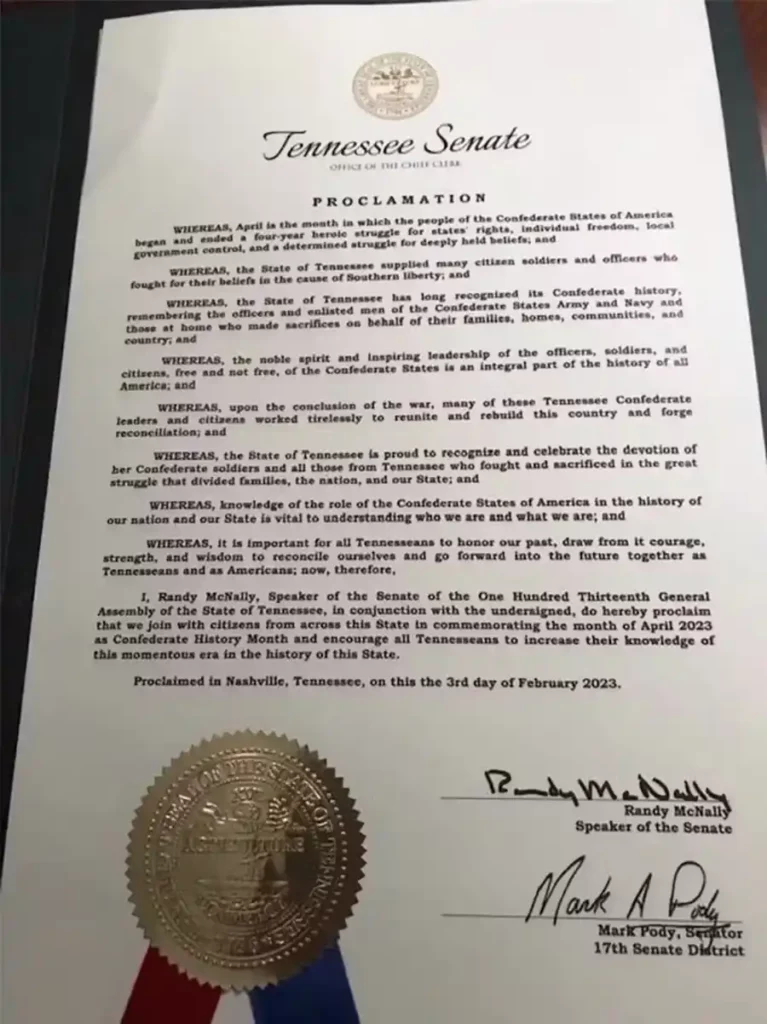
On Feb. 3, 2023, two state senators issued a formal proclamation commemorating April 2023 as Confederate History Month and encouraging “all Tennesseans to increase their knowledge of this momentous era in the history of this State.”

One of the signers is Senate Speaker Randy McNally, who is also the state’s lieutenant governor; the other is Sen. Mark Pody from Lebanon. Though not considered in legislative session and not listed on the Legislature’s website, the proclamation holds an official stature: It was issued on Senate stationery and stamped with the Tennessee state seal.

The proclamation’s wording closely follows that of a proclamation issued by Virginia’s Gov. Robert McDonnell in April 2010, with one striking exception. McDonnell’s proclamation in final form included a paragraph, inserted after protests to an earlier version, stating “that it is important for all Virginians to understand that the institution of slavery led to this war.”

The Tennessee proclamation, which includes eight introductory clauses celebrating “the cause of Southern liberty,” says nothing of slavery at all. Rather, it declares that Confederates conducted “a four-year heroic struggle for states’ rights, individual freedom, local government control, and a determined struggle for deeply held beliefs.”

A proclamation of the Tennessee Senate
A proclamation of the Tennessee Senate declares April 2023 Confederate History Month. Tennessee State Senate, CC BY-ND

Safeguarding slavery

As we historians of the Civil War have tirelessly pointed out, the documentary record speaks clearly of the motive behind that “heroic struggle.”

Both official proceedings and private utterances prove abundantly that there was only one reason to secede from the United States and create a new Confederacy. That was to safeguard racial slavery from the threat posed by the election of an antislavery Northerner, Abraham Lincoln, as president of the United States.

Tennessee seceded later than other states, after the Confederate firing on Fort Sumter. Lincoln’s responding call for troops made plain that there would be a war and that Tennessee, like other fence-sitting Upper South states, would have to choose sides.

The record of the state’s reasons is easy to find, and would have been available to the authors of the recent proclamation. In 2021, the University of Tennessee Press published “Tennessee Secedes: A Documentary History.” It shows that in Tennessee, as elsewhere, the protection of slavery was the sole motive for secession.

In 1861, Gov. Isham Harris convened the state’s Legislature with a message denouncing the North’s “systematic, wanton, and long continued agitation of the slavery question,” crowned by the insulting election of a president who “asserted the equality of the black with the white race.”

Harris went on:

“To evade the issue thus forced upon us at this time, without the fullest security for our rights, is, in my opinion, fatal to the institution of slavery forever. The time has arrived when the people of the South must prepare either to abandon or to fortify and maintain it. Abandon it, we cannot, interwoven as it is with our wealth, prosperity and domestic happiness.”

In all the deliberations that followed, no cause or grievance but slavery was mentioned.

Yet these basic facts go unacknowledged in a proclamation that boldly declares that knowledge of Confederate history is “vital to understanding who we are and what we are.”

Other omissions in the proclamation are equally curious.

Tennessee’s role in the Confederacy was uniquely conflicted. Thousands of citizens, especially in mountainous East Tennessee, opposed secession. Ignoring “local government control,” the state suppressed their dissent by force.

Some 50,000 Tennesseans, white and Black, spurned the Confederacy and fought for the United States – more than from any other Confederate state. The proclamation silently erases not only their struggle and sacrifice but their very existence.

‘Be not deceived by names’

Whether the Confederacy should be celebrated or condemned depends inescapably on point of view.

The proclamation casts the Confederacy in the mode of the American Revolution. The picture it paints is of a noble, if unsuccessful, attempt to erect a new self-governing independent nation – ignoring the fact that the institution of human slavery was at its center, as the Confederate constitution made clear.

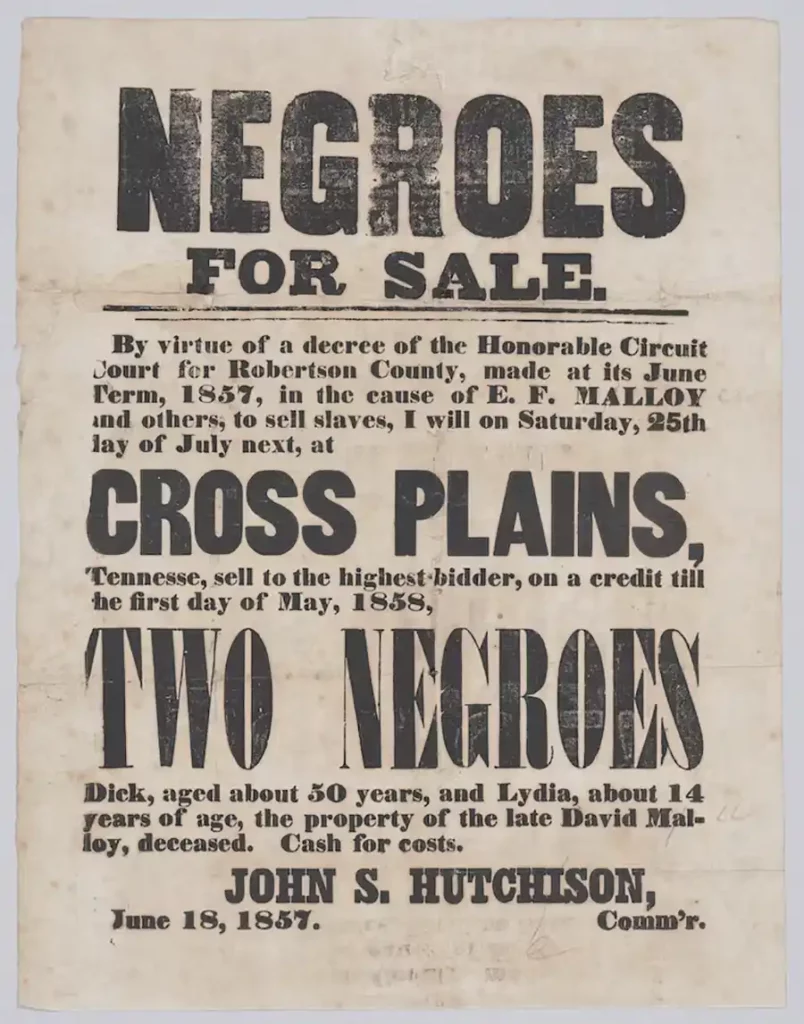
A broadside from 1857, John S. Hutchison announcing the sale of two enslaved people
Broadside announcing the sale of an enslaved man named Dick and an enslaved girl named Lydia in Cross Plains, Tenn., dated June 18, 1857. Heritage Art/Heritage Images via Getty Images

Yet from another perspective, the Confederacy was nothing more than an armed mass rebellion against a legitimately elected government.

It was, ironically, a famous Tennessean, President Andrew Jackson, who had warned would-be seceders in an official proclamation in 1832: “Be not deceived by names. Disunion by armed force is treason. Are you really ready to incur its guilt?”

Lincoln labeled the Confederacy an “insurrection” within the United States itself, which the government and loyal citizens had not only a right but a duty to put down.

In words that echo today, Lincoln also observed that if the United States won its battle against forcible dismemberment, “it will then have been proved that, among free men, there can be no successful appeal from the ballot to the bullet; and that they who take such appeal are sure to lose their case, and pay the cost.”

Celebrating insurrection

The old adage that the victors write history is true at least to this extent. Generally the American Revolutionaries are deemed patriot heroes rather than rebels and traitors because they won their war, and because the course of subsequent history appears to have vindicated their cause.

Yet many Confederate acolytes, the proclamation’s sponsors among them, seem to have difficulty confronting what the Confederacy actually stood for. Hence, citizens serving in government – who upon entering their offices take a solemn oath to uphold and defend the United States Constitution and begin their daily sessions by pledging allegiance to “one Nation indivisible” – chose to officially exalt a failed attempt to overthrow that Constitution and dismember the nation that it bound together.

Under a statute enacted in 2021, Tennessee public school teachers are barred from using instructional materials “promoting or advocating the violent overthrow of the United States government.”

No such prohibition applies to state legislators.The Conversation

Daniel Feller, Emeritus Professor of History, University of Tennessee

This article is republished from The Conversation under a Creative Commons license. Read the original article.

Filed Under: News

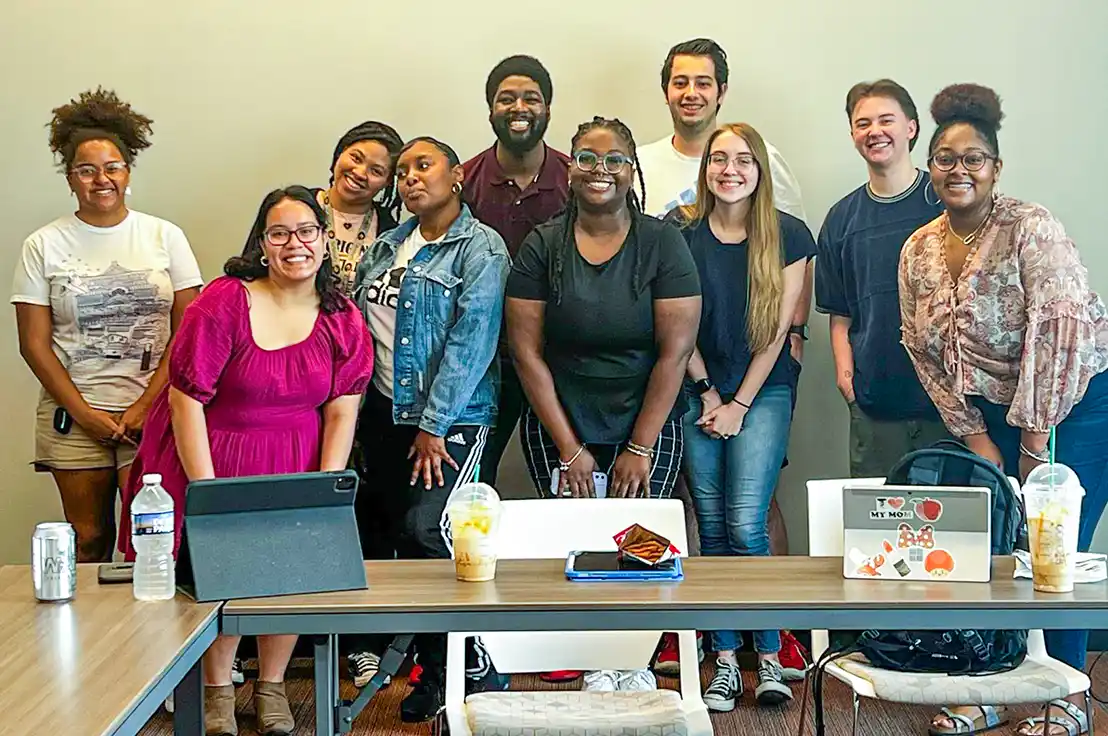
A photo of the 2023 Bridge Program Participants

Summer 2024 Bridge Program Schedule

May 5, 2023

Tuesday, May 7: Welcome

  • Staggered arrivals
  • 5:00 pm: TBD
  • 6:00 pm: Welcome Reception in UT Conference Center Room 406, 600 Henley Street, Knoxville TN

Wednesday, May 8: Introduction to the Profession and to Graduate Study

All daytime events will meet in UT Conference Center Room 403, 600 Henley Street. Evening event is at the Volunteer Landing Marina.

  • 9:00-9:30: Session 1: Orientation: How to Prepare for the Next Three Days
  • 9:45-10:45 am: Session 2: History as a Profession: Exclusions and Opportunities
  • 10:45-10:55 am: Break
  • 10:55-12:35: Session 2: Panel of Historians in the Field (via Zoom)
    • Featuring: Dr. Jocelyn Imani, Dr. Kelli Mosteler, Dr. Crystal Moten
  • 12:35-2:00 pm: Lunch  
  • 2:00-3:15 pm: Session 3: What to Expect in Graduate School
  • 3:15-3:25 pm: Break
  • 3:25-4:55 pm: Session 5: Graduate student panel
  • 6:00 pm: Volunteer Princess Sunset Cruise on the Tennessee River. Meet at Volunteer Landing Marina. Shuttle bus pickup from Day 1 location.

Thursday, May 9: Doing research, Sharing research

First event of the day is at Hodges Library. All other daytime events will meet in Student Union, room 262A.

  • 9:30-10:15: Session 6: Thinking about your Research Interests
    • Meet at Hodges Library, Public Services, 1015 Volunteer Blvd.
    • Featuring Professor Shaina Destine, MLIS
  • 10:15-11:15: Session 7: Library Resources: what are they for, how can they help you?
  • 11:15-11:30: Break, walk to Student Union 262A
  • 11:30 am-12:45 pm: Session 8: Faculty Experiences in History
  • 12:45-1:45: Lunch
  • 1:45-2:45: Session 9: Student Share Outs 1
  • 2:45-3:50: Session 10: Student Share Outs 2
  • 3:50-4:00: Break
  • 4:00-5:00: Session 11: Faculty break out mentoring sessions
  • 5:00-5:30: Quick Prep Session: Look up two graduate programs
  • 6:30 pm: Graduate Student Night on the Town at Maple Hall (Bowling…bring socks!)

Friday, May 10: Demystifying the Application Process

All daytime events will meet in Student Union, room 169. 

Featuring: Dr. Tore Olsson and Dr. Luke Harlow

  • 9:15-10:00 am: Session 12: Keynote Address from UTK Bridge Program Alumnus
  • 10:00-10:45: Session 13: Dr. Ernest Brothers, Associate Dean of the Graduate School
  • 10:45-11:00: Break
  • 11:00-12:30: Session 14: Finding and Choosing a Graduate Program
  • 12:30-1:30 pm: Lunch
  • 1:30-2:45 pm: Session 15: Statement of Purpose Workshop
  • 2:45-3:05 pm: Break
  • 3:05-4:15 pm: Session 16: Other Materials – GRE & GPA, CV and writing sample
  • 4:15-5:00 pm: Session 17: Financial Matters, From Start to Finish
  • 5:00-5:20 pm: Exit survey, Next Steps, and Farewells

Saturday, May 11: Departures

Filed Under: News

A photo of Mary Beckley

Staffer Mary Beckley, a Kidney Transplant Recipient, Finds Harmony in History

April 21, 2023

A photo of Mary Beckley

As an administration specialist II for the Department of History, Mary Beckley wears many hats: scheduler, purchaser, publicist, inventory clerk, and all-around problem-solver. 

“There’s always moving parts,” she said. “It means I can’t stop learning myself.” 

A “military brat,” Beckley was born in South Carolina and lived in Japan for 3.5 years as a young child. The family then moved to Austin, Texas, where Beckley lived until she graduated from high school. She then moved to East Tennessee to attend Maryville College, her grandparents’ alma mater.

Beckley earned a bachelor’s degree in music education and, over the years, she’s taught private music lessons and volunteered with the Joy of Music School.

“Music is one of my lifelong loves,” said Beckley who has played piano since age 5. “Originally the plan was to become a music teacher.”

But during college she struggled with illness—the result of a genetic kidney disease—and soon after graduating, started on dialysis. Six months later she had a kidney transplant. Her donor was her sister Sarah, a lecturer at Clemson.

Once she recovered enough to work, Beckley needed to find a job with good insurance. She joined UT’s temp pool in 2007 and started working as a graduate school coordinator in the School of Architecture. The next year, she was offered the full-time job in history.

“I’m extremely, extremely lucky to be where I am,” she said. “I’ve had nothing but support from everyone I work with.”

Fifteen years after her transplant, Beckley is doing well. She married her husband, Rick, in 2010.

“I’m in good health. I watch my diet and I exercise. I do have to watch for getting tired and staying clear of the latest bug going around. And I have to be careful not to sit too long because that will mess up my circulation,” she said. 

Landing in the history department has been a nice fit for Beckley in other ways, too.

“I, personally, am a lover of history,” she said, adding that her mother was a librarian and taught high school history.  “I grew up surrounded by history books. She collected them like crazy. I never thought of history as boring. It was one of those things I always wanted to know more about.”

During her time at UT, Beckley has seen a major shift from keeping paper files to doing most administrative work online. Greater use of technology means questions about computers and software. Beckley said she’s tried to school herself in all of that to troubleshoot many issues without calling for help.

“I do like detail and solving problems,” she said. But, she admits, that can be “like death by a thousand papercuts. There’s always detail upon detail to think about.”

In her spare time, Beckley enjoys reading, writing, and listening to live music.

“I’m a faithful Big Ears Festival ticketholder,” she said. Some favorite concerts she’s experienced—other than Paul McCartney—have included singer/songwriter/pianist Tori Amos, blues/rock/soul/hip-hop artist Gary Clark Jr., and “punk rock laureate” Patti Smith.

—Story by Amy Blakely

Filed Under: News

Duygu Yıldırım

Yıldırım awarded 2023 ACLS Fellowship

April 19, 2023

Duygu Yıldırım

Duygu Yıldırım, an assistant professor of history at UT, has been awarded a 2023 ACLS Fellowship from the American Council of Learned Societies (ACLS) in support of her book project, Uncertain Knowledge: The Making of Slow Science between the Ottoman Empire and Early Modern Europe.

The ACLS Fellowship Program supports exceptional scholarship in the humanities and interpretive social sciences that has the potential to make significant contributions within and beyond the awardees’ fields. Yıldırım is one of 60 early-career scholars from around the country who were selected through a multi-stage peer review from a pool of nearly 1,200 applicants. ACLS Fellowships provide between $30,000 and $60,000 to support scholars during six to 12 months of sustained research and writing.

“With higher education under sustained attack around the country, ACLS is proud to support this diverse cohort of emerging scholars as they work to increase understanding of our connected human histories, cultures, and experiences,” said ACLS President Joy Connolly. “ACLS

Fellowships are investments in an inclusive future where scholars are free to pursue rigorous, unflinching humanistic research.”

Yıldırım’s work explores the role of uncertainty during the globalization of scientific and medical knowledge in the late seventeenth and early eighteenth centuries. Her book project will show how the rhetoric of uncertainty became a new mode of inquiry and a highly productive new strategy to accommodate emerging anxieties about human diversity, confessional and inter-religious conflict, and the fragmentary knowledge of newly circulated medicinal substances and plants.

Taking comparative and connective perspectives that bridge the Ottoman and European contexts of the early modern period, Yıldırım’s book will offer a more granular picture of knowledge-making during a time when science lost its assertive firmness and became more provisional, revocable, and all-in-all slower in an increasingly global world.

Yıldırım was previously awarded a 2023-2024 Faculty Research Fellowship from the UT Humanities Center. As an ACLS Fellow, she will still participate in the Humanities Center’s events throughout the year alongside the center’s cohort of fellows.

Filed Under: News

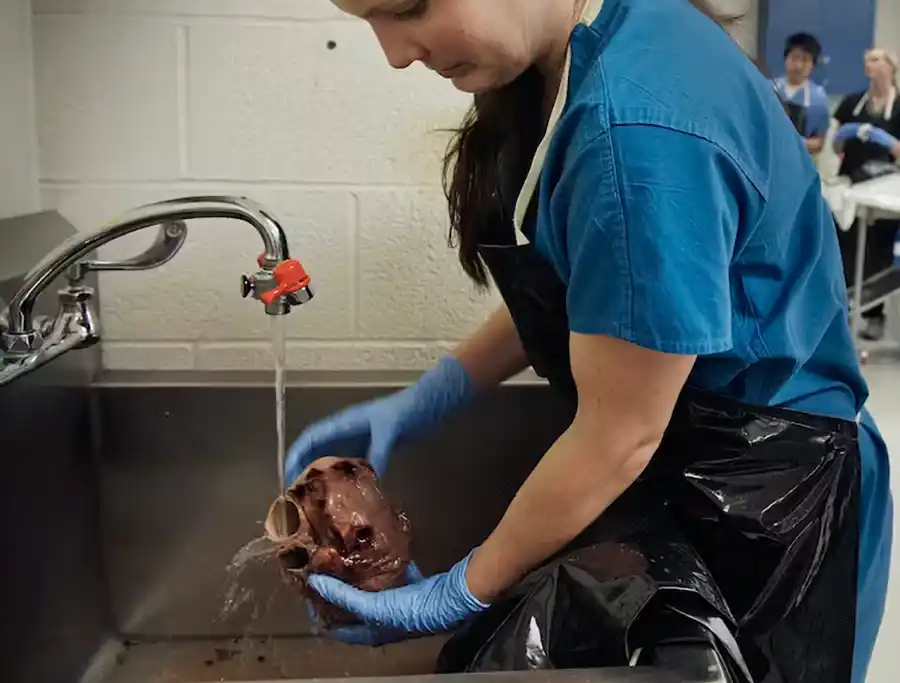
A Georgetown University medical student washing an organ from a donated cadavers her anatomy class in 2011

From grave robbing to giving your own body to science – a short history of where medical schools get cadavers

March 10, 2023

A Georgetown University medical student washing an organ from a donated cadavers her anatomy class in 2011
These Georgetown University medical students used donated cadavers in their anatomy class in 2011. Bill O’Leary/The Washington Post via Getty Images

Susan Lawrence, University of Tennessee and Susan E. Lederer, University of Wisconsin-Madison

In 1956, Alma Merrick Helms announced that she was bound for Stanford University. But she would not be attending classes. Upon learning that there was a “special shortage of women’s bodies” for medical students, this semiretired actress had filled out forms to donate her corpse to the medical college upon her death.

As historians of medicine, we had long been familiar with the tragic tales of 18th- and 19th-century grave robbing. Medical students had to snatch unearthed bodies if they wanted corpses to dissect.

But there was little to no discussion of the thousands of Americans in the 20th century who wanted an alternative to traditional burial – those men and women who gave their bodies to medical education and research.

So we decided to research this especially physical form of philanthropy: people who literally give themselves away. We are now writing a book on this topic.

Grave robbing and executed criminals

As more and more medical schools opened before the Civil War, the profession faced a dilemma. Doctors needed to cut open dead bodies to learn anatomy because no one wanted to be operated on by a surgeon who had only been trained by studying books.

But for most Americans, cutting up dead human beings was sacrilegious, disrespectful and disgusting.

According to the ethos of the day, only criminals deserved such a fate after death, and judges intensified murderers’ death sentences by adding the insult of dissection after their executions. As in life, the bodies of enslaved people were also exploited in death, either consigned for dissection by their masters or robbed from their graves.

Yet there were never enough legally available bodies, so grave robbing flourished.

The unclaimed poor

To meet the medical professon’s growing demand for cadavers, Massachusetts enacted the first anatomy law. This measure, passed in 1831, made the bodies of the unclaimed poor available for dissection in medical schools and hospitals.

With more medical schools opening and grave-robbing scandals pushing politicians to act, similar legislation eventually took effect across the United States.

One of the most visible incidents occurred when the body of former Rep. John Scott Harrison, both the son and the father of U.S. presidents, involuntarily turned up on an Ohio dissecting table in 1878.

In many states, kin and friends could claim a body that would otherwise be destined for dissection, but only if they could pay burial costs.

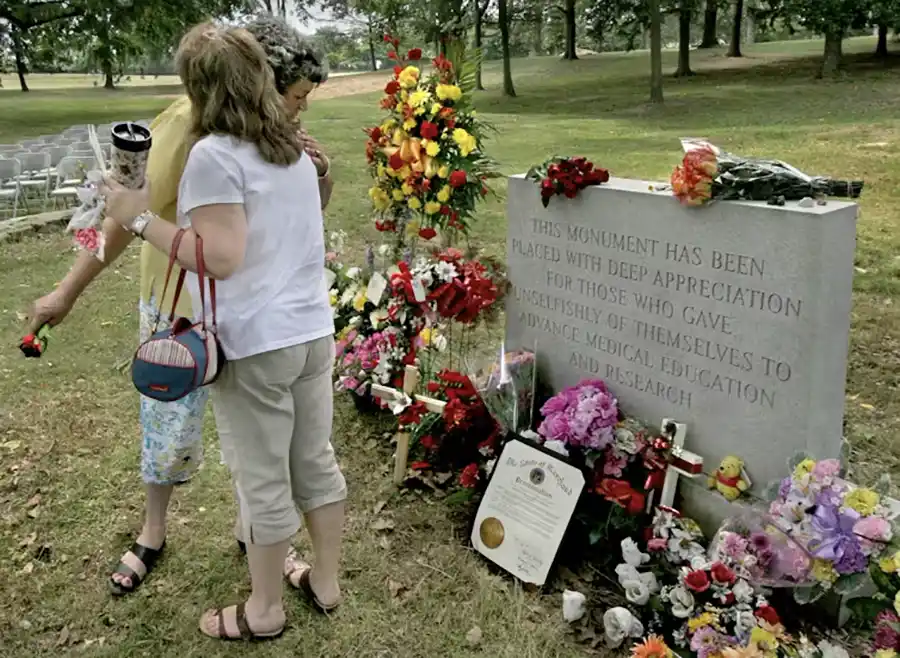
Two women hug by a monument to honor those who have donated their bodies to science
Monuments to honor those who have donated their bodies to science like this one can offer opportunities for their loved ones to mourn and remember them. Michael Williamson/The Washington Post via Getty Images

Donated bodies

Yet not everyone shared the horror at the very idea of being dissected.

By the late 19th century a growing number of Americans were willing to let medical students cut up their bodies before eventual burial or cremation. It did not apparently frighten or disgust them.

Doctors volunteered, but so did nurses, store owners, actors, academics, factory workers and freethinkers – even prisoners about to be executed. Some were people who simply sought to avoid funeral expenses.

Other Americans hoped that doctors would use their bodies to research their diseases, while others wanted to enable “medical science to enlarge its knowledge for the good of mankind,” as George Young, a former wagon-maker, requested before he died in 1901.

Cornea transplants

By the late 1930s, advances in cornea transplant surgery made it possible for Americans to gift their eyes to restore the sight of blind and visually impaired men, women and children.

Along with World War II blood drives, heartwarming stories about corneal transplants spread a radically new understanding of corporeal generosity.

As efforts to attract donors who would pledge their eyes at death spread in the 1940s and early 1950s, so too did a new problem for anatomists: a decline in the number of unclaimed bodies.

Anatomists blamed a host of factors: rising prosperity in the postwar years; new laws that allowed county, city and state welfare departments to bury the unclaimed; veterans’ death benefits; Social Security death benefits; and outreach by church groups and fraternal orders to take care of their poverty-stricken members.

Dear Abby and Reader’s Digest

By the mid-1950s concerns arose about cadaver shortages for anatomy classes. But media coverage of people who had chosen to donate their bodies started to sway others to follow suit. Good examples include a Dear Abby advice column published in 1958 and a Reader’s Digest article in 1961.

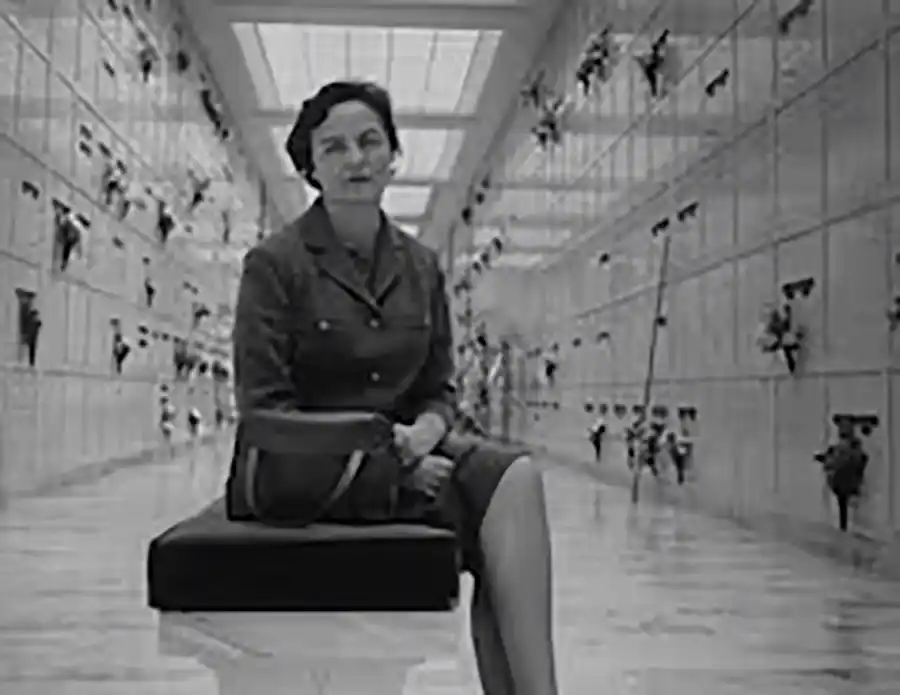
Author Jessica Mitford sits on a bench in what appears to be a mausoleum
In her exposé of the funeral industry’s problems, author Jessica Mitford endorsed donating bodies to science. Ted Streshinsky/Getty Images

In 1962, Unitarian advocate Ernest Morgan published “A Manual of Simple Burial,” which promoted memorial services as alternatives to lavish funerals. He included a directory of medical schools and dental schools that accepted whole-body donations.

Journalist Jessica Mitford, in her wildly popular 1963 book that condemned the funeral industry, “The American Way of Death,” also endorsed that practice. She helped make giving your body to science a respectable, even noble, alternative to expensive conventional burials.

In the early 1960s, Protestant, Catholic and Reform Jewish leaders also came out in favor of donating bodies to science.

By the late 1960s and early 1970s, some anatomy departments began to organize memorial services to acknowledge donors and provide some closure for their loved ones.

Word of such efforts further encouraged whole-body donation.

Letters of encouragement

We reviewed dozens of unpublished letters to and from donors in the 1950s to the early 1970s, in which anatomy professors encouraged potential whole-body donors to see themselves as heroically giving to medical science. Early donors frequently expressed this altruistic vision, wanting their mortal shells to participate in advancing knowledge.

By the mid-1980s, most medical and dental schools relied on donated bodies to teach anatomy, although a few unclaimed bodies still make their way today to medical schools. Technology has revolutionized anatomy teaching, as with the National Library of Medicine’s Visible Human Project, but cadavers are still needed.

Images and models cannot replace hands-on experience with the human body.

Where many Americans once regarded medical students as “butchers” for exploiting their beloved dead, contemporary students honor what some of these future doctors call their “first patients” for the precious gift they have been given.The Conversation

Susan Lawrence, Profesor of History, University of Tennessee and Susan E. Lederer, Professor of Medical History and Bioethics, University of Wisconsin-Madison

This article is republished from The Conversation under a Creative Commons license. Read the original article.

Filed Under: News

  • « Previous Page
  • 1
  • …
  • 3
  • 4
  • 5
  • 6
  • 7
  • Next Page »

History

College of Arts and Sciences

916 Volunteer Blvd
6th Floor, Stokely Management Center
Knoxville, TN 37996
Phone: 865-974-5421
Email: history@utk.edu


Facebook Icon    X Icon    Instagram Icon    Soundcloud Icon

Department Intranet

The History department has transferred all internal documentation shared by faculty, graduate students, and staff to a Microsoft SharePoint site. Only those with permission may access this area.

The University of Tennessee, Knoxville
Knoxville, Tennessee 37996
865-974-1000

The flagship campus of the University of Tennessee System and partner in the Tennessee Transfer Pathway.

ADA Privacy Safety Title IX